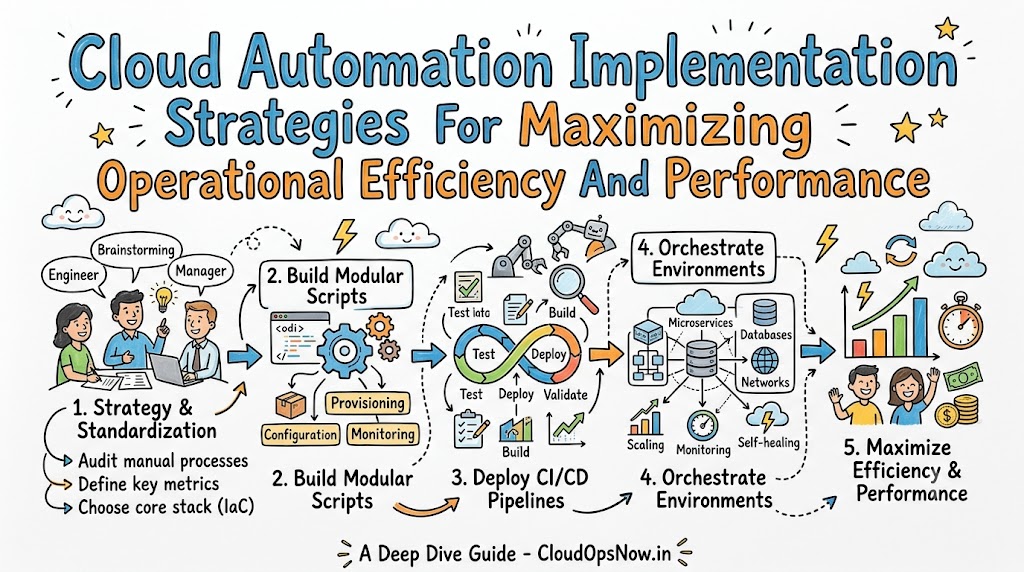
Cloud infrastructure has evolved into a dynamic ecosystem where manual management methods are no longer sufficient for enterprise demands. As software architectures shift toward microservices and continuous deployment, manual provisioning introduces critical delays and human errors. Automation bridges this gap by replacing repetitive administrative tasks with repeatable, code-driven workflows. Consequently, organizations can ensure system availability, maintain security compliance, and optimize operational costs effortlessly.
To build a reliable digital framework, modern enterprise engineering teams partner with specialized leaders like Cloudopsnow to design custom workflow automation architectures. Automating standard processes transforms reactive IT management into an agile operational strategy. Furthermore, eliminating routine maintenance overhead allows developers to dedicate their focus to building core application features. Modern cloud automation provides the foundation for scalable, secure, and resilient digital infrastructures.
Key Operational Concepts You Must Know
Understanding the Core Foundations of Cloud Automation
Cloud automation refers to the programmatic orchestration of cloud computing tasks without human intervention. It spans infrastructure provisioning, resource configuration, deployment, and ongoing system management. By converting operational procedures into code, organizations achieve consistency across development, staging, and production environments. Consequently, automation minimizes manual misconfigurations and establishes predictable deployment cycles.
+-------------------+      API Triggers       +-------------------+
|                   | ----------------------> |                   |
|  Automation Code  |                         |  Cloud Resources  |
|                   | <---------------------- |                   |
+-------------------+    Telemetry & Status   +-------------------+
Automating tasks provides clear advantages over legacy manual system management. Rather than configuring servers individually, engineers execute scripts that automatically provision fully configured virtual environments in minutes. This shift accelerates time-to-market while creating audit trails for all infrastructure changes. By replacing manual actions with code, operational teams build scalable systems that adapt to shifting business demands.
The Critical Role of Infrastructure as Code
Infrastructure as Code allows operations teams to define, provision, and manage cloud assets using declarative code files. This paradigm treats hardware configurations identically to application code, enabling version control, code reviews, and automated testing. When changes are required, engineers update the codebase rather than making manual adjustments in cloud management consoles.
- Version Control: Tracks every configuration change in Git repositories, enabling rapid audit trails and easy rollbacks.
- Consistency: Prevents configuration drift by ensuring every environment matches the exact codebase definition.
- Replicability: Allows operations teams to clone entire production stacks in minutes for testing or disaster recovery scenarios.
Using code-driven infrastructure reduces human error during deployments while standardizing resource setups. If an environment experiences issues, engineers can destroy and re-provision the entire infrastructure from clean source code within minutes. This capability simplifies maintenance and ensures operational environments remain stable over time.
Automated Orchestration vs. Basic Scripting
Basic scripting automates single, isolated tasks, such as executing a database backup or creating a local user account. In contrast, cloud orchestration coordinates multiple complex automation scripts across disparate systems into a unified workflow. While a script manages a single server, orchestration manages interconnected applications, networks, and databases across multiple regions.
[ Basic Scripting ]   ---> Executes single task on one target resource.

[ Cloud Orchestration ] -> [ Task 1: Provision Network ]
                                     |
                                     v
                           [ Task 2: Launch Compute ]
                                     |
                                     v
                           [ Task 3: Deploy Software ]
Orchestration platforms manage system dependencies, resource ordering, and error-handling routines across entire application topologies. For example, an orchestration engine provisions virtual networks, spins up database instances, deploys application containers, and updates DNS records automatically. Understanding this distinction allows operations teams to progress from simple task scripting to comprehensive platform automation.
Continuous Integration and Continuous Deployment Pipelines
Continuous Integration and Continuous Deployment pipelines automate the lifecycle of software applications from code commit to production delivery. CI automatically builds, tests, and validates code changes as developers submit them to shared repositories. CD extends this process by automatically deploying validated code to target cloud environments without manual intervention.
By automating build and deployment stages, engineering teams shorten release cycles from months to hours. Automated test suites verify code changes against performance and security benchmarks before pushing them live. This rapid feedback loop identifies software defects early, protecting production environments from stability issues.
Platform Implementation vs. Culture — What’s the Real Difference?
| Operational Aspect | Platform Implementation Focus | Cultural & Mindset Focus |
|---|---|---|
| Tooling and Infrastructure | Deploying orchestration frameworks, configuring CI/CD engines, and managing API endpoints. | Standardizing team communication, encouraging continuous learning, and eliminating operational silos. |
| Monitoring and Observability | Installing monitoring agents, aggregating telemetry logs, and configuring metric dashboards. | Establishing clear SLO targets, prioritizing user impact, and refining alert responses. |
| Incident Management | Triggering automated auto-scaling policies, executing rollbacks, and running remediation scripts. | Conducting blameless incident reviews, analyzing root causes, and updating operational workflows. |
| Resource Optimization | Tuning auto-scaling schedules, optimizing container footprints, and managing resource tags. | Embedding cost awareness in architecture phases, valuing efficiency, and setting budget accountability. |
Technical Execution vs. Behavioral Alignment
Platform implementation focuses on deploying the tools, scripts, and software configurations necessary to automate cloud infrastructure. Teams select orchestration engines, configure automated deployment pipelines, and write infrastructure code definitions. While these technical frameworks are essential, they represent only the mechanical elements of operational transformation. Without proper behavioral alignment, technical automation tools often fail to deliver their full organizational value.
Cultural transformation addresses how teams communicate, collaborate, and approach operational responsibility across the organization. A mature cloud culture encourages developers and operations engineers to share responsibility for application performance and system uptime. When teams cultivate shared ownership, developers naturally design applications that integrate cleanly with automated infrastructure tools. Merging technical tooling with cultural alignment establishes a resilient operational engine capable of sustained innovation.
Bridging the Gap Between Tools and Processes
To realize the full benefits of cloud automation, organizations must align automated tooling directly with operational processes. Installing advanced deployment platforms provides little value if governance frameworks still require manual sign-offs for routine updates. Organizations should audit existing approval workflows, replacing bureaucratic friction with automated compliance testing within delivery pipelines.
   +---------------------------+
   |   Engineering Culture     |  <-- Encourages shared accountability and agility
   +---------------------------+
                 |
                 v
   +---------------------------+
   |   Automated Processes     |  <-- Replaces manual sign-offs with code validation
   +---------------------------+
                 |
                 v
   +---------------------------+
   |  Platform Infrastructure  |  <-- Executes deployments and provisions resources
   +---------------------------+
Building this bridge requires shared documentation, cross-functional training, and continuous refining of operational runbooks. When developers understand infrastructure rules, they build code that works harmoniously with automated scaling and self-healing systems. This shared understanding converts automation platforms into enablers of rapid software delivery. Ultimately, aligning technology with operational culture produces consistent, high-performing cloud environments.
Real-World Use Cases of Modern Operations
Self-Healing Application Architectures
Self-healing architectures rely on automated health checks and remediation logic to recover from failures without human intervention. When a cloud instance crashes or experiences memory exhaustion, monitoring systems detect the anomaly immediately. Instead of paging an engineer during non-business hours, automated platforms isolate the failed instance and launch a healthy replacement.
[ Application Cluster ] ---> (Health Check Detects Node Failure)
                                      |
                                      v
[ Automated Controller ] ---> [ Terminate Unhealthy Instance ]
                                      |
                                      v
                             [ Provision Replacement Node ] ---> (System Restored)
These automated recovery workflows extend to application dependencies and network configurations as well. If a primary database node becomes unresponsive, automated orchestration engines promote a read replica to primary status instantly. By automating common failure recoveries, organizations maintain strict uptime SLAs and minimize operational downtime. Consequently, self-healing platforms deliver smooth, uninterrupted experiences for global users.
Dynamic Auto-Scaling for Variable Workloads
E-commerce and media platforms experience dramatic shifts in user traffic based on marketing campaigns, news events, or peak hours. Manual capacity planning often leads to either over-provisioning unused resources or under-provisioning during critical traffic spikes. Cloud auto-scaling automates capacity management by adjusting compute resources dynamically based on real-time metrics.
- Metric Tracking: Monitors CPU utilization, network throughput, and queue depth continuously.
- Scale-Out Rules: Automatically launches additional instances when system metrics cross target thresholds.
- Scale-In Logic: Safely terminates surplus nodes when traffic cools down, protecting against overspending.
Dynamic scaling ensures applications remain fast and responsive during massive, unpredictable traffic events. By automating capacity adjustments, companies avoid paying for idle infrastructure during off-peak hours. This balance between performance and expenditure highlights the operational value of cloud automation.
Automated Security Compliance and Remediation
Modern enterprise environments must meet strict regulatory compliance standards across all cloud assets. Manual security audits are slow, error-prone, and often leave security gaps unaddressed for extended periods. Cloud automation continuously evaluates environments against security baselines, ensuring non-compliant resources are corrected instantly.
[ Compliance Engine ] ---> Scans Environment Continuously
                                 |
                                 v
                     [ Detects Open Storage Bucket ]
                                 |
                                 v
                     [ Applies Security Policy ] ---> (Bucket Secured Automatically)
If an engineer accidentally exposes a storage bucket or launches an unencrypted database, automated policies detect the misconfiguration. The automation platform can revoke access privileges, enforce encryption, or isolate the non-compliant resource automatically. This proactive security framework minimizes vulnerabilities, protects sensitive user data, and simplifies compliance auditing.
Common Mistakes in Operations Engineering
Over-Automating Fragile Processes Without Standardizing
A frequent mistake in cloud engineering is automating broken or non-standardized operational workflows. Automating a chaotic process simply speeds up the generation of operational errors across your cloud infrastructure. Before writing automation scripts, operations teams must standardize, simplify, and document their workflows thoroughly.
Manual Chaos + Automation Engine = Automated Chaos at Scale
Standardized Workflow + Automation Engine = Scalable Operational Efficiency
Engineers should avoid creating overly complex automation scripts that handle dozens of edge cases simultaneously. Instead, build small, modular automation blocks that perform single tasks reliably and predictably. Standardizing operational procedures before applying automation tools ensures predictable results and simplifies system maintenance.
Ignoring Security Secrets Management in Code Repositories
Hardcoding API keys, database passwords, and SSH keys directly into automation scripts or code repositories poses a severe risk. When infrastructure code is committed to shared version control systems, exposed credentials can be exploited rapidly by malicious actors.
[ Bad Practice ]  ---> Infrastructure Code + Hardcoded Credentials ---> [ Public Repo ] (Compromised)

[ Best Practice ] ---> Infrastructure Code + External Vault Key  ---> [ Secure Environment ]
Teams must integrate centralized secrets management vaults directly into their automated execution pipelines. Automation tools should pull credentials securely at runtime using temporary access tokens rather than static keys. This security discipline protects sensitive cloud systems while preserving seamless automated execution.
Neglecting Infrastructure Drift and Manual Hotfixes
Infrastructure drift occurs when team members make manual changes directly to cloud resources, bypassing configuration code. These manual hotfixes create discrepancies between the recorded code definition and the actual production environment. Over time, drift causes automated deployments to fail unpredictably due to unknown infrastructure modifications.
[ Code State ]  -------------------> Defines Baseline Environment
                                             |
                                             v  (Manual Console Edit Introduced)
[ Real State ]  -------------------> Drift Created -> (Automated Pipeline Fails)
To combat drift, teams must enforce strict access policies that prevent manual edits in production environments. Organizations should deploy drift-detection pipelines that scan cloud setups continuously for unauthorized modifications. Automatically resetting drifted resources back to their coded definitions maintains system integrity and ensures reliable deployments.
How to Become an Operations Expert — Career Roadmap
Mastering Fundamental Scripting and API Integration
To build a career in cloud operations, you must start by mastering scripting languages and RESTful API interactions. Python and Bash form the core language foundation for writing automation scripts, interacting with system tools, and handling JSON data. Understanding how to query, parse, and manipulate API payloads allows you to control cloud services programmatically.
- Language Fundamentals: Learn Python and Bash syntax, error handling, and file manipulation.
- API Mechanics: Understand HTTP methods, authentication headers, rate limits, and JSON parsing.
- Version Control: Master Git workflows to track, manage, and collaborate on automation code safely.
Building strong coding fundamentals allows you to transition from manual administration to code-driven system engineering. Practice writing scripts that query cloud APIs, extract metric data, and automate simple maintenance routines. This hands-on foundation is essential for mastering modern automation frameworks.
Gaining Expertise in Infrastructure as Code and Orchestration Tools
Once you master basic scripting, progress to declarative Infrastructure as Code tools like Terraform and OpenTofu. Learn to write modular, reusable code definitions that construct complete network topographies, compute nodes, and security rules. Mastering state file management, module design, and pipeline integration is crucial for building production-grade infrastructure.
+-------------------+      Executes Code      +-------------------+
|  Terraform Code   | ----------------------> | Multi-Cloud Assets |
|  & State File     |                         | Provisioned Cleanly|
+-------------------+                         +-------------------+
Complement your IaC knowledge by learning container orchestration platforms like Kubernetes and automated CI/CD engines like GitLab CI or GitHub Actions. Study how container platforms handle service discovery, rolling updates, and internal load balancing. This technical skill set positions you as a core contributor capable of automating complete enterprise environments.
Developing Advanced Observability and System Optimization Competency
Elite operations professionals focus on observability, system optimization, and proactive engineering strategies. You must learn to aggregate telemetry data—metrics, logs, and traces—using platforms like Prometheus, Grafana, and OpenTelemetry. Understanding how to analyze system metrics allows you to build proactive auto-scaling rules and self-healing workflows.
             +---------------------------------------+
             |    Centralized Observability Hub      |
             +---------------------------------------+
               ^                 ^                 ^
               |                 |                 |
        [System Metrics]  [Distributed Traces]  [Structured Logs]
        (Prometheus)       (OpenTelemetry)      (Log Aggregators)
Additionally, develop your expertise in cost optimization, performance tuning, and chaos engineering practices. Learn to run failure injection tests to verify that automated self-healing mechanisms respond correctly under stress. Combining observability insights with automated remediation transforms you into a key operational leader.
FAQ Section
- What is the primary difference between cloud automation and cloud orchestration?Cloud automation focuses on automating single tasks, such as provisioning a server or running a script. Cloud orchestration coordinates multiple automated tasks across complex systems into a unified workflow. Orchestration manages task sequencing, dependencies, and conditions across entire cloud platforms.
- How does Infrastructure as Code prevent configuration drift?Infrastructure as Code defines resource setups in version-controlled code files rather than manual console settings. Automated tools compare running environments against this baseline code regularly to identify unauthorized edits. Re-applying the code definition automatically restores resources to their intended state.
- Why is secrets management critical in automated deployment pipelines?Automated deployment pipelines require elevated privileges to provision and manage cloud assets. Hardcoding static credentials in scripts risks exposing sensitive access keys in code repositories. Centralized secrets management provides temporary, encrypted tokens at runtime, securing access without compromising automation.
- Can cloud automation help reduce infrastructure spending?Yes, cloud automation optimizes resource usage by scheduling non-production environments to shut down outside business hours. Auto-scaling rules scale compute nodes up or down based on real-time traffic demand automatically. This prevents paying for idle resources during low-activity periods.
- How does self-healing automation handle application node crashes?Self-healing systems continuously evaluate server health using automated monitoring tools. When a node fails health checks, the controller terminates the unhealthy instance and provisions a fresh node automatically. Traffic is rerouted to healthy instances without requiring manual intervention from engineers.
Final Summary
Transforming cloud operations through automation requires a balanced approach that combines code-driven tools, structured workflows, and a collaborative engineering culture. By adopting Infrastructure as Code, automated CI/CD pipelines, and dynamic scaling mechanisms, organizations achieve reliable and scalable cloud performance. Eliminating manual configurations reduces deployment errors, protects application uptime, and keeps operational overhead manageable. Embracing automation empowers engineering teams to build resilient architectures that scale effortlessly alongside modern business demands.
