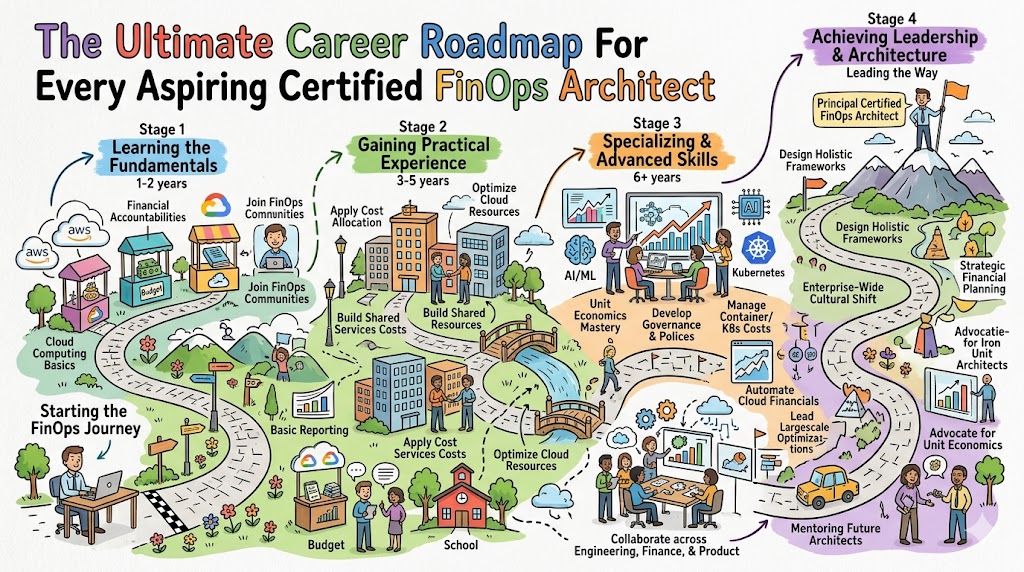
Modern cloud environments demand a sophisticated approach to financial management where engineering meets fiscal accountability. This guide explores the Certified FinOps Architect designation for professionals aiming to bridge the gap between cloud infrastructure and business value. By mastering these principles, engineers can ensure that cloud scaling remains sustainable and profitable. This comprehensive roadmap assists cloud practitioners, architects, and financial leaders in navigating the complexities of high-level cloud financial operations. Achieving this certification through FinOpsSchool validates your ability to design and implement complex financial frameworks within cloud-native ecosystems.
What is the Certified FinOps Architect?
The Certified FinOps Architect represents the pinnacle of cloud financial management expertise, focusing on the architectural decisions that drive cost efficiency. Unlike entry-level programs, this designation emphasizes the structural integration of financial accountability into the software development lifecycle. It exists to ensure that cloud-native designs are not just technically sound but also economically viable for large-scale enterprises. Professionals holding this title demonstrate a deep understanding of how specific architectural patterns impact the monthly cloud bill.
This certification focuses heavily on production-focused strategies rather than theoretical concepts found in standard documentation. It aligns perfectly with modern engineering workflows by introducing financial checkpoints into CI/CD pipelines and infrastructure-as-code templates. Organizations today prioritize architects who can predict and control spending while maintaining high performance and reliability. By focusing on real-world scenarios, the program prepares engineers to lead cross-functional teams in high-stakes cloud environments.
Who Should Pursue Certified FinOps Architect?
Cloud architects and Senior DevOps engineers find the most significant career leverage by pursuing the Certified FinOps Architect credential. These roles are naturally positioned to influence infrastructure decisions that have the largest impact on organizational spending and resource utilization. Furthermore, Site Reliability Engineers (SREs) benefit by learning how to balance the “error budget” with the actual financial budget. Managers who oversee large engineering departments also gain the vocabulary needed to justify infrastructure costs to executive leadership.
In the global market, especially within the rapidly expanding tech sectors in India, the demand for cost-conscious architects is surging. Beginners with a strong foundation in cloud computing can use this path to differentiate themselves in a competitive job market. Experienced professionals use it to transition from purely technical roles into strategic leadership positions that influence company-wide policy. Security and data engineers also find value here, as data egress and storage costs often represent the most volatile part of a cloud budget.
Why Certified FinOps Architect is Valuable and Beyond
The longevity of the Certified FinOps Architect role is secured by the permanent shift of global enterprises toward multi-cloud and hybrid environments. As cloud complexity increases, the ability to architect for “unit economics” becomes a mandatory skill for any senior technical leader. This program helps professionals stay relevant even as specific cloud tools change because the core economic principles remain constant. It provides a massive return on time investment by shifting an engineer’s perspective from “how to build” to “how to build profitably.”
Enterprises are moving away from reactive cost-cutting toward proactive financial architecture, creating a massive vacuum for certified experts. Professionals who can prove their ability to reduce waste while increasing velocity are the most sought-after individuals in the current economy. This certification serves as a signal to employers that the candidate understands the business impact of technical choices. It effectively future-proofs a career against automation, as strategic financial architecture requires human judgment and organizational negotiation.
Certified FinOps Architect Certification Overview
The program is delivered via the official portal and is hosted on FinOpsSchool, providing a centralized hub for all learning materials. The assessment approach moves beyond simple multiple-choice questions to evaluate a candidate’s ability to solve complex, multi-layered financial problems. It is structured into practical modules that cover everything from cost allocation and tagging strategies to advanced reserved instance management. Ownership of the certification rests with a body dedicated to establishing global standards for cloud financial excellence.
Candidates engage with a structure that mirrors the actual lifecycle of a cloud project, from initial design to ongoing optimization. The curriculum is designed to be vendor-neutral, ensuring that the skills learned are applicable across AWS, Azure, and Google Cloud Platform. By focusing on the practical application of the FinOps Framework, the program ensures that graduates can immediately impact their organization’s bottom line. The rigorous assessment ensures that only those with a true grasp of architectural finance earn the title.
Certified FinOps Architect Certification Tracks & Levels
The certification hierarchy begins with foundation levels designed to establish a common language across finance and engineering teams. As practitioners progress to the professional level, the focus shifts toward the execution of optimization strategies and automated governance. Finally, the advanced architect level challenges the student to design global-scale financial operations that span multiple business units. Each level is carefully mapped to specific career milestones, ensuring a logical progression from individual contributor to strategic lead.
Specialization tracks allow professionals to tailor their learning toward DevOps, SRE, or even DataOps, depending on their current professional focus. These tracks ensure that a FinOps Architect in a data-heavy organization has the specific skills needed to manage massive storage costs. The alignment with career progression is clear: foundation for junior roles, professional for seniors, and advanced for principals and directors. This tiered approach prevents information overload and allows for a focused deep-dive into the most relevant subject matter.
Complete Certified FinOps Architect Certification Table
| Track | Level | Who it’s for | Prerequisites | Skills Covered | Recommended Order |
|---|---|---|---|---|---|
| Core FinOps | Foundation | Junior Engineers/Finance | Cloud Basics | Cost Transparency, Tagging | First |
| Engineering | Professional | Senior DevOps/SRE | Foundation Cert | Automated Scaling, Spot Usage | Second |
| Architecture | Advanced | Principal Architects | Professional Cert | Multi-cloud Governance, Unit Economics | Third |
| Leadership | Executive | Engineering Directors | General Management | Budgeting, Cultural Change | Optional |
Export to Sheets
Detailed Guide for Each Certified FinOps Architect Certification
Certified FinOps Architect – Foundation
What it is This certification validates a professional’s understanding of the basic FinOps lifecycle: Inform, Optimize, and Operate. It ensures the candidate understands the terminology and the necessity of cloud financial management.
Who should take it It is ideal for junior cloud engineers, procurement specialists, and financial analysts who are new to the cloud ecosystem. It serves as the essential first step for anyone entering the field.
Skills you’ll gain
- Mastery of the FinOps “Inform” phase and cost visibility.
- Understanding of cloud billing constructs and invoice reconciliation.
- Ability to implement basic tagging and resource labeling standards.
Real-world projects you should be able to do
- Create a basic dashboard showing cloud spend by department.
- Identify orphaned resources and unattached storage volumes.
Preparation plan
- 7-14 Days: Focus on the official glossary and core FinOps principles.
- 30 Days: Complete practice exams and review cloud billing documentation.
- 60 Days: Not typically required for foundation unless the candidate is entirely new to tech.
Common mistakes Candidates often underestimate the importance of the “Culture” aspect of FinOps, focusing only on the technical tools.
Best next certification after this
- Same-track: Certified FinOps Professional
- Cross-track: Cloud Practitioner (AWS/Azure)
- Leadership: FinOps for Managers
Certified FinOps Architect – Professional
What it is The Professional level validates the ability to execute optimization strategies across complex environments. It proves the candidate can move beyond reporting and into the actual reduction of cloud waste.
Who should take it Suitable for SREs and DevOps Engineers with at least two years of cloud experience. It is designed for those who have the permissions to change infrastructure settings.
Skills you’ll gain
- Advanced commitment-based discount management (RI/Savings Plans).
- Implementation of automated “Rightsizing” workflows.
- Ability to build automated governance policies via code.
Real-world projects you should be able to do
- Design an automated system to shut down dev environments after hours.
- Implement a cross-account cost allocation model for shared services.
Preparation plan
- 7-14 Days: Review advanced cloud pricing models and API-based billing tools.
- 30 Days: Work through hands-on labs focusing on automation scripts.
- 60 Days: Deep dive into case studies regarding large-scale optimization.
Common mistakes Focusing too much on one cloud provider and ignoring the nuances of multi-cloud financial management.
Best next certification after this
- Same-track: Certified FinOps Architect (Advanced)
- Cross-track: Kubernetes Administrator (CKA)
- Leadership: Technical Program Manager
Certified FinOps Architect – Advanced
What it is This is the highest level of certification, validating the ability to design the entire financial architecture of an enterprise. It focuses on long-term strategy, unit economics, and organizational transformation.
Who should take it Principal Architects, CTOs, and Lead FinOps Practitioners should pursue this level. It requires a deep understanding of both high-level business goals and low-level technical constraints.
Skills you’ll gain
- Ability to calculate and track “Unit Economics” (Cost per transaction).
- Designing global governance frameworks for multi-billion dollar spends.
- Leading cultural shifts to integrate finance into engineering DNA.
Real-world projects you should be able to do
- Develop a three-year cloud financial roadmap for a Fortune 500 company.
- Create a custom “Chargeback” and “Showback” system for diverse business units.
Preparation plan
- 7-14 Days: Review executive communication strategies and financial reporting.
- 30 Days: Analyze complex enterprise architecture patterns for cost.
- 60 Days: Engage in peer reviews and study large-scale migration economics.
Common mistakes Failing to align technical architecture with the specific business outcomes of the organization.
Best next certification after this
- Same-track: Specialized Platform Engineering
- Cross-track: AI/ML Optimization Specialist
- Leadership: MBA or Executive Leadership Program
Choose Your Learning Path
DevOps Path
The DevOps path focuses on integrating financial metrics directly into the CI/CD pipeline. Engineers learn to treat “Cost” as a first-class requirement, similar to performance or security. By mastering FinOps, DevOps professionals can build deployment scripts that automatically choose the most cost-effective instance types. This path ensures that every code commit is evaluated for its potential impact on the overall cloud budget.
DevSecOps Path
In this track, the focus is on the intersection of security compliance and cost management. Professionals learn how security tools and logging strategies can lead to massive cost spikes if not architected correctly. You will explore how to implement cost-effective security monitoring and data retention policies. This path is essential for ensuring that protecting the cloud environment doesn’t become financially prohibitive.
SRE Path
Site Reliability Engineers use this path to balance system availability with cost efficiency. The goal is to define “Service Level Objectives” that consider the financial cost of achieving high nines of availability. SREs learn to use FinOps data to decide when to scale horizontally versus vertically. This specialization ensures that the pursuit of reliability remains within the boundaries of fiscal responsibility.
AIOps Path
AIOps focuses on using machine learning to predict cloud spend and identify anomalies automatically. Professionals in this path learn to build or implement AI models that can spot cost spikes before they become disasters. This involves analyzing historical billing data to forecast future requirements with high precision. It is the future of automated, intelligent cloud financial management.
MLOps Path
Machine Learning operations involve significant costs related to GPU usage and massive data processing. This path teaches architects how to optimize the training and deployment phases of the ML lifecycle. You will learn to manage the expensive infrastructure required for large language models and deep learning. Mastering FinOps in MLOps is critical for making artificial intelligence projects commercially viable.
DataOps Path
The DataOps path addresses the unique financial challenges of data lakes, warehouses, and egress fees. Architects learn how to design data pipelines that minimize movement costs and optimize storage tiers. Since data costs often grow exponentially, this path is vital for any organization dealing with big data. You will master the art of balancing data accessibility with storage expenditures.
FinOps Path
This is the pure-play path for those dedicated to the FinOps profession as a standalone career. It covers the full breadth of the framework, from cultural change to advanced technical optimization. Practitioners on this track become the central point of contact between the CFO and the Engineering teams. It is designed for those who want to lead a formal FinOps Center of Excellence.
Role → Recommended Certified FinOps Architect Certifications
| Role | Recommended Certifications |
| DevOps Engineer | FinOps Associate, Professional Cloud Developer |
| SRE | FinOps Professional, Site Reliability Associate |
| Platform Engineer | FinOps Architect, Infrastructure Specialist |
| Cloud Engineer | FinOps Associate, Cloud Solutions Architect |
| Security Engineer | FinOps Specialist, Cloud Security Professional |
| Data Engineer | DataOps FinOps, Big Data Architect |
| FinOps Practitioner | Professional FinOps, Advanced FinOps Architect |
| Engineering Manager | FinOps Leadership, IT Financial Management |
Next Certifications to Take After Certified FinOps Architect
Same Track Progression
After reaching the Advanced Architect level, professionals should focus on hyper-specialization within their chosen cloud provider. This might involve deep-diving into AWS Advanced Networking or Azure Solutions Architect Expert. Continuous learning is required as cloud providers release new pricing models and services monthly. Staying within the track means becoming the ultimate authority on cloud financial operations for a specific ecosystem.
Cross-Track Expansion
Broadening your skills involves moving into adjacent fields like Platform Engineering or Kubernetes Management. Understanding how container orchestration impacts cost is a natural next step for any FinOps Architect. You might also pursue certifications in data engineering to better understand the costs of modern analytics. This makes you a more versatile leader who can solve problems across different technical domains.
Leadership & Management Track
For those looking to move into executive roles, the next step is focusing on business strategy and organizational leadership. This involves learning how to manage large teams and influence the “C-suite” regarding technology investments. Certifications in project management or even an MBA can complement your technical FinOps background. It prepares you to transition from a technical architect to a business-focused Chief Technology Officer.
Training & Certification Support Providers for Certified FinOps Architect
DevOpsSchool
Providing a robust ecosystem for technical learners, this platform offers extensive resources for those seeking to master cloud financial management. Their curriculum focuses on the integration of DevOps tools with financial accountability, ensuring a holistic learning experience. Students benefit from community support and industry-vetted materials that bridge the gap between theory and practice.
Cotocus
This provider specializes in high-end technical training with a focus on enterprise-grade cloud architecture. Their approach to FinOps education emphasizes the practical side of managing large-scale infrastructure costs. Through hands-on labs and real-world scenarios, they help professionals gain the confidence needed to handle complex financial environments.
Scmgalaxy
As a long-standing community for software configuration and DevOps, they provide unique insights into the financial aspects of the development lifecycle. Their resources help architects understand how build processes and deployment strategies impact the bottom line. It is an excellent choice for those who want to see the “big picture” of software delivery costs.
BestDevOps
This platform curates the best practices in the industry to offer a streamlined path toward certification success. Their focus is on efficiency, helping professionals learn the most critical skills in the shortest amount of time. They provide clear, concise guides that cut through the noise of traditional technical documentation.
devsecopsschool.com
Focusing on the vital intersection of security and operations, this site ensures that financial management is never sacrificed for safety. Their training modules explore how to build secure environments that remain cost-effective. This is a primary resource for security professionals looking to add financial architectural skills to their portfolio.
sreschool.com
Reliability and cost are two sides of the same coin at this educational hub. They offer specialized content for Site Reliability Engineers who need to manage budgets alongside uptime. The training focuses on using financial data to make better architectural decisions for system stability.
aiopsschool.com
This provider leads the way in teaching how artificial intelligence can be used to optimize cloud financial operations. Their courses cover the latest tools and techniques for automated cost forecasting and anomaly detection. It is the go-to source for architects looking to stay on the cutting edge of AIOps.
dataopsschool.com
Addressing the specific needs of data professionals, this platform offers deep dives into the economics of data management. Learners discover how to optimize storage, compute, and egress for massive data sets. The curriculum is tailored for those who manage the world’s most data-intensive cloud environments.
finopsschool.com
As the primary host and provider for the architect certification, this site offers the most direct and comprehensive path to success. Their materials are specifically designed to align with the official certification standards. It remains the definitive source for all things related to the FinOps Architect journey.
Frequently Asked Questions (General)
- How difficult is the Certified FinOps Architect exam compared to other cloud certs?
The architect level is significantly more challenging than standard associate certifications as it requires solving complex business and technical puzzles.
- What is the typical time commitment required to pass?
Most professionals spend between 30 to 60 days of focused study, depending on their existing cloud experience.
- Are there any mandatory prerequisites before taking the architect exam?
While not always strictly enforced, having a foundation-level understanding and a few years of cloud experience is highly recommended.
- What kind of salary increase can I expect after getting certified?
Many professionals see a 15% to 25% increase in compensation as they move into specialized cost-management roles.
- Does this certification expire?
Most certifications in this domain require renewal or continuing education every two to three years to ensure skills remain current.
- Is it better to focus on a specific cloud provider or a neutral certification?
A neutral certification like this provides a broader career path, though provider-specific knowledge is always beneficial.
- How does FinOps differ from traditional IT financial management?
FinOps is a decentralized, real-time approach where engineers take ownership of their spend, unlike the centralized, slow-moving traditional models.
- Can a non-technical person pass the architect exam?
It would be extremely difficult, as the exam requires a deep understanding of cloud infrastructure and architectural patterns.
- What tools are covered in the training?
The training covers a mix of native cloud provider tools and third-party platforms for cost management and automation.
- Is the exam proctored online or at a testing center?
Most modern certifications offer a flexible online proctored option for global accessibility.
- Are there practice exams available?
Yes, most training providers include several practice tests that mirror the style and difficulty of the actual exam.
- How does this certification help an Engineering Manager?
It provides the data-driven framework needed to justify budgets and demonstrate the ROI of technical projects to executives.
FAQs on Certified FinOps Architect
- What specifically does an “Architect” do in a FinOps context?
A FinOps Architect designs the systems that track and control costs, such as automated tagging policies and rightsizing engines. They ensure that every new architectural design is reviewed for financial impact before it is deployed to production.
- How do I justify the cost of this certification to my employer?
Explain that the skills learned will likely pay for the certification cost within the first month by identifying and eliminating cloud waste. Frame it as a strategic investment in the company’s long-term cloud sustainability and profitability.
- Is the Certified FinOps Architect relevant for small startups?
Absolutely, as startups need to burn as little cash as possible to extend their runway. Even basic FinOps principles can save a small company thousands of dollars a month, which is critical for early-stage survival.
- Does this certification cover Kubernetes and container costs?
Yes, the advanced levels specifically address the complexity of container cost allocation and the challenges of shared cluster resources. You will learn how to attribute Kubernetes spend back to specific teams or applications.
- What is the most important skill for a FinOps Architect?
The ability to communicate technical costs in business terms is the most critical skill. You must be able to explain to a developer why their code is expensive and to a CFO why that expense might be necessary.
- How does FinOps handle “Shadow IT”?
FinOps provides the visibility needed to find unmanaged accounts and bring them into the centralized governance framework. An architect designs the guardrails that prevent shadow IT from creating unmonitored financial risks.
- Can I use these skills for on-premises data centers?
While the focus is on cloud, the principles of unit economics and resource efficiency can be applied to any infrastructure environment. However, the automated scaling and billing aspects are specific to cloud-native ecosystems.
- Is there a focus on multi-cloud environments?
Yes, a major part of the architect’s role is managing the different billing structures and discount models across AWS, Azure, and Google Cloud. You will learn how to create a unified financial view of a multi-cloud estate.
Final Thoughts: Is Certified FinOps Architect Worth It?
The transition to the cloud was the first wave of the modern tech revolution; the second wave is the optimization of that cloud. As a mentor, I see many engineers who can build complex systems but few who can build them efficiently. Earning the Certified FinOps Architect designation places you in that elite group of professionals who understand the business of technology. It is not just about saving money; it is about making sure every dollar spent on the cloud drives actual value for the organization.
The investment in this certification is an investment in your ability to lead at the highest levels of engineering. Companies are no longer giving out “blank checks” for cloud growth; they are demanding accountability and precision. By becoming an architect in this space, you stop being a cost center and start being a value creator. If you want to be the person who can navigate both a boardroom and a bash terminal, this is the right path for you.
