Introduction
Modern enterprises increasingly struggle with fragmented data pipelines and inefficient delivery lifecycles, making the CDOM – Certified DataOps Manager a critical credential for leadership. This guide serves professionals navigating the intersection of big data and agile operations, specifically those aiming to bridge the gap between technical execution and business value. By prioritizing the DataOpsSchool curriculum, engineers and managers can effectively streamline data workflows while ensuring high reliability. This comprehensive roadmap assists global professionals in evaluating how this certification aligns with their long-term career goals in platform engineering and cloud-native environments.
What is the CDOM – Certified DataOps Manager?
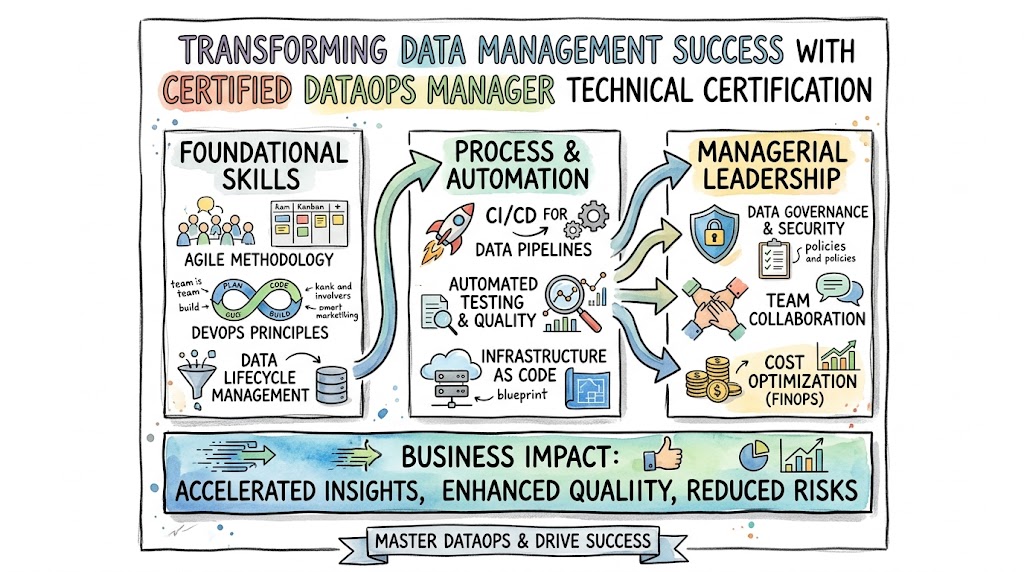
The CDOM – Certified DataOps Manager represents a shift from traditional database administration toward a dynamic, automated approach to data lifecycle management. It exists to solve the “data bottleneck” by teaching leaders how to apply DevOps principles like continuous integration and automated testing to data environments. This certification emphasizes production-focused learning, ensuring that candidates understand how to manage live data systems rather than just theoretical models. It aligns perfectly with enterprise practices where data is treated as code, requiring rigorous versioning and quality control.
Who Should Pursue CDOM – Certified DataOps Manager?
This certification is designed for senior data engineers, site reliability engineers, and cloud architects who want to move into strategic leadership roles. Engineering managers and technical leads responsible for large-scale data platforms will find the curriculum particularly relevant for managing diverse teams. It also benefits security and compliance officers who must oversee data governance within automated pipelines. Both beginners entering the data field and experienced professionals in India and across the globe can use this to validate their ability to manage complex data ecosystems.
Why CDOM – Certified DataOps Manager is Valuable and Beyond
The demand for skilled data managers continues to soar as organizations realize that raw data is useless without a reliable delivery mechanism. This program offers longevity because it focuses on architectural principles and cultural shifts rather than just specific, fleeting software tools. Professionals who earn this credential stay relevant by mastering the orchestration of people, processes, and technology in a way that survives toolchain migrations. The return on investment is visible through accelerated project delivery times and a significantly reduced rate of data-related production errors.
CDOM – Certified DataOps Manager Certification Overview
The program is delivered via the official certification portal and hosted on the primary website to ensure high standards of technical training. It utilizes a multi-level assessment approach that evaluates both conceptual knowledge and the practical ability to govern data operations. The structure is designed by industry experts to cover the full spectrum of the DataOps manifesto, ensuring ownership and accountability across the pipeline. Candidates engage with a curriculum that balances technical depth with the managerial oversight required for enterprise-scale deployments.
CDOM – Certified DataOps Manager Certification Tracks & Levels
The certification is structured into three primary tiers: foundation, professional, and advanced, allowing for a gradual mastery of the subject. Foundation levels focus on the core tenets of data agility, while professional levels dive into specialized tracks like SRE for data and FinOps-driven data scaling. Advanced tracks are tailored for aspiring CTOs or Head of Data roles, focusing on organizational transformation and global governance. This tiered approach ensures that every professional, regardless of their current standing, has a clear path for career progression.
Complete CDOM – Certified DataOps Manager Certification Table
| Track | Level | Who it’s for | Prerequisites | Skills Covered | Recommended Order |
| Data Governance | Foundation | Aspiring Managers | Basic Data Knowledge | Policy Automation | 1 |
| Pipeline Ops | Professional | Data Engineers | 2 Years Experience | CI/CD for Data | 2 |
| Data Leadership | Advanced | Directors/VPs | 5+ Years Experience | Strategic Scaling | 3 |
| Quality Assurance | Professional | QA Engineers | Testing Background | Automated Validation | 2 |
Detailed Guide for Each CDOM – Certified DataOps Manager Certification
CDOM – Certified DataOps Manager – Foundation Level
What it is
This certification validates a fundamental understanding of the DataOps methodology and the ability to identify inefficiencies in standard data lifecycles. It confirms the candidate knows how to align data teams with agile business requirements.
Who should take it
It is suitable for junior data analysts, entry-level engineers, or project managers who are new to the concept of automated data delivery. It acts as an ideal starting point for anyone transitioning from traditional IT roles.
Skills you’ll gain
- Understanding the DataOps Manifesto principles.
- Mapping data value streams.
- Basic version control for data schemas.
- Identification of data silos.
Real-world projects you should be able to do
- Creating a basic automated data ingestion report.
- Documenting a data workflow for a small team.
Preparation plan
The 7-14 days strategy involves reviewing core terminology and the DataOps manifesto. The 30 days plan includes hands-on labs with basic pipeline tools. The 60 days strategy adds deep dives into case studies of successful cultural transformations.
Common mistakes
Candidates often focus too much on specific coding languages rather than the overarching process and cultural requirements. Another error is ignoring the collaborative nature of DataOps between developers and consumers.
Best next certification after this
- Same-track option: CDOM Professional.
- Cross-track option: DevOps Foundation.
- Leadership option: Certified Agile Leader.
Choose Your Learning Path
DevOps Path
Engineers following this path focus on integrating data pipelines into existing CI/CD frameworks to ensure seamless software delivery. They learn how to treat data as a first-class citizen in the deployment process, reducing friction between dev and data teams. This path emphasizes infrastructure as code and the automation of data environment provisioning. Professionals here typically move into Platform Engineering roles with a heavy emphasis on data reliability.
DevSecOps Path
This trajectory focuses on the “Security Left” approach within the data lifecycle, ensuring that privacy and compliance are automated. Professionals learn to integrate masked data sets into testing environments and automate vulnerability scanning for data warehouses. It is essential for those working in highly regulated industries like finance or healthcare. The goal is to ensure that data speed does not compromise the security posture of the organization.
SRE Path
The Site Reliability Engineering path for data focuses on the availability, latency, and performance of data systems. Candidates learn to define Service Level Objectives for data freshness and accuracy, ensuring that pipelines are resilient to failures. This path involves mastering error budgets for data processing and building robust monitoring and alerting systems. It is the ideal route for those who want to ensure that high-volume data stays “always on.”
AIOps Path
Professionals on this path use machine learning to improve the operations of IT environments by analyzing massive amounts of log data. They focus on predictive maintenance and automated root cause analysis to reduce the mean time to resolution for system incidents. This requires a deep understanding of how to manage the specialized data sets used by AI models. It bridges the gap between traditional operations and advanced data science.
MLOps Path
This path targets the lifecycle management of machine learning models, from training and deployment to monitoring and retraining. It ensures that data scientists can push models to production with the same rigor and speed as software developers. Professionals learn to manage model versioning, data drift, and feature stores. This is a critical role for any organization looking to scale their artificial intelligence initiatives.
DataOps Path
The core DataOps path is dedicated to the total optimization of the data supply chain through automation and collaboration. It focuses specifically on reducing the cycle time of data analytics while maintaining high quality and governance standards. Candidates master the orchestration of complex data environments and the elimination of manual handoffs. This path creates specialists who can revolutionize how an organization consumes and trusts its data.
FinOps Path
This path focuses on the financial management of data in the cloud, ensuring that scaling data operations remains cost-effective. Professionals learn to track data storage and egress costs, identifying areas for optimization without sacrificing system performance. It involves creating a culture of financial accountability among data engineers and architects. This is vital for maintaining the economic sustainability of large-scale cloud data platforms.
Role → Recommended CDOM – Certified DataOps Manager Certifications
| Role | Recommended Certifications |
| DevOps Engineer | CDOM Foundation, Pipeline Ops |
| SRE | Data Reliability Professional |
| Platform Engineer | CDOM Advanced, Infrastructure Lead |
| Cloud Engineer | Cloud DataOps Specialist |
| Security Engineer | Secure Data Architect |
| Data Engineer | CDOM Professional, Quality Specialist |
| FinOps Practitioner | Data Cost Optimizer |
| Engineering Manager | CDOM – Certified DataOps Manager |
Next Certifications to Take After CDOM – Certified DataOps Manager
Same Track Progression
Once the manager level is achieved, professionals should look toward executive-level certifications that focus on global data strategy. Deep specialization in specific cloud data architectures, such as Snowflake or Databricks, can also complement the managerial foundation. The goal is to move from managing a team to governing an entire enterprise data ecosystem.
Cross-Track Expansion
Broadening skills into SRE or DevSecOps allows a DataOps manager to understand the holistic needs of the modern platform. Understanding how security affects data flow or how site reliability impacts data availability makes for a more versatile leader. This expansion ensures that the professional can lead multi-disciplinary teams across different departments.
Leadership & Management Track
Transitioning into high-level leadership often requires certifications in business administration or strategic organizational change. Mastering the “human” side of technical management, including conflict resolution and budget planning, is the next logical step. These certifications prepare DataOps professionals to take on roles like Chief Data Officer or VP of Engineering.
Training & Certification Support Providers for CDOM – Certified DataOps Manager
DevOpsSchool
This provider offers extensive resources for professionals looking to master the integration of operations and development within data contexts. Their programs focus on real-world scenarios that prepare candidates for high-pressure enterprise environments. They provide a balanced mix of video tutorials and live lab sessions to ensure practical competence.
Cotocus
Specializing in niche technical certifications, this organization provides tailored coaching for those pursuing advanced management credentials. Their trainers are often industry veterans who bring a wealth of practical experience to the classroom. They focus on the specific challenges of scaling data operations in cloud-native startups.
Scmgalaxy
As a community-driven platform, they offer a vast repository of knowledge and tools for version control and configuration management. Their support for DataOps candidates includes detailed guides on treating data as code. They emphasize the technical rigor required to maintain consistent data pipelines across various environments.
BestDevOps
This provider is known for its streamlined curriculum that focuses on the most essential skills for modern engineering roles. They offer accelerated paths for experienced professionals who need to validate their skills quickly. Their certification support includes mock exams that closely mirror the actual assessment environment.
devsecopsschool.com
Focusing on the intersection of security and operations, this site provides the necessary training to build secure data pipelines. They help professionals understand how to automate compliance without slowing down the delivery of data. Their courses are essential for those in the DevSecOps track.
sreschool.com
This institution focuses on the reliability and stability of large-scale systems, including complex data architectures. They provide the tools and techniques needed to maintain high availability in data processing. Their curriculum is highly technical and aimed at those who value system uptime above all.
aiopsschool.com
For those looking to leverage artificial intelligence in their operational workflows, this provider offers cutting-edge training. They focus on the data requirements of AIOps and how to manage the resulting insights. Their courses bridge the gap between operations and advanced analytics.
dataopsschool.com
As the primary host for the CDOM program, this site offers the most direct and comprehensive path to certification. They provide all the official materials, lab environments, and expert guidance required to succeed. It is the central hub for all things related to DataOps excellence.
finopsschool.com
This provider helps professionals master the economic side of cloud and data operations. Their training focuses on cost visibility and optimization, which is a key component of the CDOM advanced curriculum. They are essential for managers who are accountable for departmental budgets.
Frequently Asked Questions (General)
- How difficult is the CDOM certification for a mid-level engineer?
It requires a solid understanding of both data engineering and agile processes, making it moderately challenging for most. - What is the typical time commitment for preparation?
Most candidates spend between 30 and 60 days depending on their prior experience with automation. - Are there any mandatory prerequisites before taking the exam?
While not always mandatory, having a few years of experience in data or DevOps is highly recommended. - What is the return on investment for this certification?
Professionals often see higher salary offers and improved leadership opportunities within their current organizations. - Is there a specific sequence I should follow for the tracks?
Starting with the foundation and moving to the professional level is the most logical and effective path. - How does this certification differ from a standard Data Engineering certificate?
It focuses on the process, management, and automation of the lifecycle rather than just technical data manipulation. - Is the exam based on multiple-choice questions or practical labs?
It usually involves a combination of both to test theoretical knowledge and practical application. - How long does the certification remain valid?
Certifications typically remain valid for two to three years before requiring a renewal or upgrade. - Can I take the exam online from any location?
Yes, the platform supports remote proctoring to accommodate professionals from around the world. - Are there community groups available for study support?
Many of the training providers host forums and Slack channels for candidates to collaborate. - Does the program cover specific tools like Jenkins or Airflow?
It covers the architectural use of such tools rather than being a “how-to” guide for one specific brand. - Is this certification recognized by major global enterprises?
Yes, it is increasingly requested by large-scale tech companies and financial institutions.
FAQs on CDOM – Certified DataOps Manager
- What core problem does the CDOM program solve for a business?
It addresses the lack of coordination between data producers and consumers by creating a standardized, automated management framework. This reduces the “time-to-insight” for business stakeholders. - How does the curriculum handle data privacy and compliance?
The program integrates governance as an automated step in the pipeline, ensuring that every piece of data remains compliant throughout its lifecycle without requiring manual audits. - Does the certification focus more on people or technology?
It provides a balanced view, teaching that technology is the enabler but cultural shift and process design are the primary drivers of success. - Is this suitable for someone moving from a traditional DBA role?
Absolutely, it is the perfect bridge for DBAs to transition into modern cloud-native and DevOps-oriented data management roles. - How are the practical labs structured in this program?
Labs simulate real-world production environments where candidates must fix broken pipelines and optimize slow data flows under realistic constraints. - Can managers with a non-technical background pass this?
It requires a basic technical understanding, but the primary focus is on management and process orchestration, making it accessible to technical managers. - What is the focus of the advanced leadership track?
The advanced level focuses on organizational change, high-level strategy, and managing the total cost of ownership for data platforms. - How often is the curriculum updated to reflect new trends?
The curriculum is reviewed annually to incorporate shifts in cloud technology and new methodologies in the data space.
Final Thoughts: Is CDOM – Certified DataOps Manager Worth It?
Investing in the CDOM – Certified DataOps Manager is a strategic move for any professional aiming to lead in a data-driven world. It moves beyond the hype of individual tools and addresses the fundamental architectural challenges that modern companies face. If you are responsible for the delivery and reliability of data at scale, this certification provides the necessary framework to succeed. It is not just about a title; it is about gaining the authority and skill set to transform how your organization handles its most valuable asset. For those committed to the long-term evolution of data operations, this path offers clear, measurable value.
