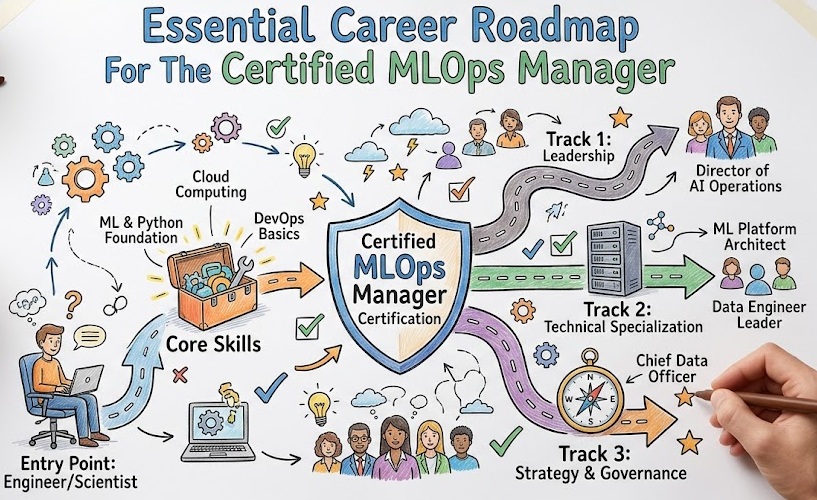
The evolution of artificial intelligence from experimental notebooks to production-scale systems has created a massive demand for leadership in machine learning operations. If you want to understand how to bridge the gap between data science and reliable engineering, this guide for the Certified MLOps Manager serves as your primary resource. Navigating the complexities of model deployment, monitoring, and governance requires a structured approach that integrates DevOps principles with the unique lifecycle of AI. At AIOpsSchool, professionals gain the frameworks necessary to lead these high-stakes initiatives. This guide helps engineers and technical leaders evaluate how this certification aligns with their specific career goals and long-term professional development within the cloud-native ecosystem.
What is the Certified MLOps Manager?
The Certified MLOps Manager represents a professional standard for individuals tasked with overseeing the lifecycle of machine learning models in enterprise environments. It exists to solve the “last mile” problem of AI, where models often fail to reach production due to a lack of operational rigor. This program emphasizes production-focused learning, moving beyond basic model training to focus on CI/CD for ML, automated testing, and infrastructure scalability. It aligns with modern engineering workflows by treating models as first-class citizens in a software delivery pipeline. Organizations utilize this framework to ensure that their AI investments deliver consistent value through stable and reproducible engineering practices.
Who Should Pursue Certified MLOps Manager?
This path benefits a wide range of professionals, particularly those sitting at the intersection of data and operations. Senior DevOps engineers and SREs looking to specialize in AI infrastructure find immense value here, as do data scientists transitioning into leadership roles. Engineering managers and technical leads who must supervise multi-disciplinary teams will gain the vocabulary and technical oversight required for success. In the global market, including the rapidly expanding tech hubs in India, the role of an MLOps manager is becoming critical for digital transformation. Both beginners with strong foundational skills and experienced cloud professionals use this certification to validate their ability to manage complex, data-heavy systems.
Why Certified MLOps Manager is Valuable and Beyond
The demand for operationalizing AI continues to grow as enterprises realize that raw models are insufficient without robust deployment strategies. This certification provides longevity because it teaches core principles of automation and governance that remain relevant even as specific libraries or frameworks change. Professionals who master these management skills stay relevant by focusing on the systemic challenges of AI rather than just the syntax of the day. The return on time investment is significant, as it positions individuals for high-impact roles in FinTech, Healthcare, and E-commerce. By focusing on enterprise adoption, the program ensures that managers can build sustainable teams that survive the initial hype of AI projects.
Certified MLOps Manager Certification Overview
The program is delivered via the official course page and hosted on the AIOpsSchool platform. It approaches assessment through a mix of practical evaluations and theoretical understanding, ensuring that a manager knows both the “how” and the “why” of model operations. The ownership of the certification lies with an organization dedicated to bridging the gap between traditional IT operations and modern AI requirements. Its structure is designed to be practical, focusing on the governance, cost management, and security aspects of machine learning. Instead of just passing a multiple-choice test, candidates must demonstrate an understanding of how to lead teams through the complexities of the ML lifecycle.
Certified MLOps Manager Certification Tracks & Levels
The certification hierarchy typically begins with foundation levels that cover the basic terminology and components of an ML pipeline. Professional levels move into deep dives regarding automation, monitoring, and model registries, while advanced levels focus on organizational strategy and architectural governance. Specialization tracks allow professionals to align their MLOps knowledge with existing expertise in areas like FinOps for cloud costs or DevSecOps for model security. These levels follow a logical career progression, taking a practitioner from an individual contributor to a strategic leader. Each step ensures that the learner builds upon previous knowledge to tackle increasingly complex organizational challenges.
Complete Certified MLOps Manager Certification Table
| Track | Level | Who it’s for | Prerequisites | Skills Covered | Recommended Order |
|---|---|---|---|---|---|
| Foundation | Associate | Aspiring ML Engineers | Basic Cloud Knowledge | ML Lifecycle, Tooling | First |
| Operations | Professional | SREs & DevOps | 2+ Years Experience | CI/CD for ML, Monitoring | Second |
| Management | Expert | Team Leads & Managers | Professional Level | Governance, Strategy | Third |
| Security | Specialist | Security Engineers | DevOps Background | Model Privacy, Compliance | Optional |
| Finance | Specialist | FinOps Practitioners | Cloud Cost Basics | GPU Optimization, Budgeting | Optional |
Export to Sheets
Detailed Guide for Each Certified MLOps Manager Certification
Certified MLOps Manager – Foundation Level
What it is
This level validates a fundamental understanding of the machine learning operational lifecycle and the core tools used to manage it.
Who should take it
Junior engineers, project managers, and data analysts who need to understand the technical workflow of AI projects should start here.
Skills you’ll gain
- Identification of ML pipeline stages
- Understanding of versioning for data and models
- Basic knowledge of containerization for ML
Real-world projects you should be able to do
- Setting up a basic automated data ingestion pipeline
- Tracking model experiments using open-source tools
Preparation plan
- 7-14 Days: Focus on core terminology and the difference between ML and traditional software.
- 30 Days: Complete labs on data versioning and model registries.
- 60 Days: Review case studies of failed ML projects to understand operational gaps.
Common mistakes
- Focusing too much on model math rather than pipeline architecture.
- Ignoring the importance of data quality at the source.
Best next certification after this
- Same-track option: Professional MLOps Engineer
- Cross-track option: Cloud Operations Specialist
- Leadership option: Technical Project Manager
Certified MLOps Manager – Professional Level
What it is
This certification confirms the ability to design and implement end-to-end automated machine learning pipelines in a production environment.
Who should take it
Experienced DevOps engineers and Data scientists who are responsible for the uptime and reliability of AI services.
Skills you’ll gain
- Advanced CI/CD for machine learning (CT – Continuous Training)
- Real-time model monitoring and drift detection
- Infrastructure as Code for ML clusters
Real-world projects you should be able to do
- Deploying a model with automated rollback on performance degradation
- Implementing a feature store for cross-team data reuse
Preparation plan
- 7-14 Days: Master Kubernetes and container orchestration for ML workloads.
- 30 Days: Build and tear down complex pipelines using Terraform and Jenkins.
- 60 Days: Implement monitoring stacks for specialized ML metrics.
Common mistakes
- Over-engineering the pipeline for simple models.
- Failing to account for the costs of high-frequency model retraining.
Best next certification after this
- Same-track option: Expert MLOps Strategy
- Cross-track option: Site Reliability Engineer (SRE)
- Leadership option: Certified MLOps Manager
Choose Your Learning Path
DevOps Path
Professionals on this path focus on integrating machine learning into existing software delivery pipelines. They prioritize automation, consistency, and the removal of silos between data scientists and operations teams. The goal is to treat model code and data with the same rigor as application code. This path is ideal for those who enjoy building the infrastructure that makes AI possible.
DevSecOps Path
This trajectory emphasizes the security and compliance aspects of machine learning operations. Practitioners learn to protect models from adversarial attacks, secure data privacy, and ensure that all AI components meet regulatory standards. It involves scanning models for vulnerabilities and managing access controls across the data pipeline. This is a critical role for highly regulated industries like finance and healthcare.
SRE Path
The SRE path focuses on the reliability, scalability, and performance of machine learning systems in production. These experts manage service-level objectives for AI models and build automated systems to handle incidents. They use error budgets to balance the speed of model updates with the stability of the overall platform. It is a highly technical path centered on system health and observability.
AIOps Path
This specialization focuses on using AI and machine learning to improve IT operations. Managers in this area deploy tools that can predict outages, automate root cause analysis, and optimize infrastructure performance. It is about applying the very models they manage to the task of running the data center. This creates a feedback loop where AI improves the efficiency of the tech stack.
MLOps Path
The dedicated MLOps path dives deep into the specific challenges of the machine learning lifecycle, such as data drift and training-serving skew. It covers the management of feature stores, model registries, and specialized hardware like GPUs. This path ensures that models are not just built but are continuously improved and monitored throughout their lifespan. It is the core of the manager’s technical domain.
DataOps Path
DataOps focuses on the rapid, reliable delivery of high-quality data to the machine learning pipelines. Managers here oversee data engineering workflows, ensuring that the input for models is clean, versioned, and accessible. They treat data as a product, applying agile methodologies to the data supply chain. This path is essential for organizations dealing with massive, fast-moving datasets.
FinOps Path
The FinOps path deals with the financial management of AI and machine learning in the cloud. Since GPU resources and large-scale data processing can be extremely expensive, these managers focus on cost optimization and budget accountability. They analyze spending patterns to ensure that the business gets a high return on its AI investment. This is a vital role for maintaining the long-term viability of AI initiatives.
Role → Recommended Certified MLOps Manager Certifications
| Role | Recommended Certifications |
|---|---|
| DevOps Engineer | MLOps Foundation, Professional Automation |
| SRE | ML Observability, Advanced SRE |
| Platform Engineer | Infrastructure for AI, MLOps Expert |
| Cloud Engineer | Cloud-Native ML, Associate Level |
| Security Engineer | DevSecOps for ML, Governance Specialist |
| Data Engineer | DataOps Professional, Feature Store Manager |
| FinOps Practitioner | ML Cost Optimization, FinOps Specialist |
| Engineering Manager | Certified MLOps Manager, Strategic AI Leadership |
Export to Sheets
Next Certifications to Take After Certified MLOps Manager
Same Track Progression
After mastering the manager level, the next logical step is to move into strategic leadership or architectural governance. This involves looking at the entire organization’s AI portfolio rather than individual projects. You might pursue advanced certifications in AI strategy or organizational transformation. This ensures you can scale MLOps practices across dozens of different teams and business units.
Cross-Track Expansion
Broadening your skills into related fields like DevSecOps or FinOps makes you a more versatile leader. Understanding how security impacts the ML lifecycle or how to manage cloud budgets adds layers of value to your operational expertise. This expansion allows you to sit at the center of the business, technology, and security triangle. It makes you a prime candidate for Director or VP-level roles.
Leadership & Management Track
If you wish to move away from day-to-day technical tasks, you can focus on executive management certifications. These programs emphasize people management, vendor selection, and aligning AI capabilities with business revenue goals. You will learn how to build high-performing teams and communicate the value of MLOps to non-technical stakeholders. This is the ultimate path for those aiming for a CTO or CDO position.
Training & Certification Support Providers for Certified MLOps Manager
DevOpsSchool This provider offers extensive resources for professionals looking to master the automation side of MLOps. They focus on practical labs and real-world scenarios to ensure students can handle production-level challenges effectively.
Cotocus They specialize in high-end consulting and training, helping enterprises adopt modern engineering practices. Their approach is heavily focused on the integration of various DevOps and AI tools within a cohesive pipeline.
Scmgalaxy As a community-driven platform, they provide a wealth of knowledge on configuration management and continuous integration. Their content is highly beneficial for those who want to understand the deep technical roots of MLOps.
BestDevOps This site offers a curated look at the best practices in the industry, focusing on quality and reliability. They provide guides that help practitioners stay updated with the latest trends in software delivery and AI operations.
devsecopsschool.com This platform is the go-to resource for integrating security into the machine learning lifecycle. They provide specialized training on how to secure data pipelines and protect models from external threats.
sreschool.com Focusing on the reliability aspect, this provider teaches the principles of site reliability engineering as applied to AI. Students learn how to manage service levels and build resilient systems that can handle scale.
aiopsschool.com This is the primary host for the MLOps manager certification, offering a comprehensive curriculum tailored for the modern AI era. They provide the most direct path to mastering the operational side of artificial intelligence.
dataopsschool.com They focus on the data engineering and management side of the house, ensuring that the foundation of any AI project is solid. Their training covers everything from data quality to automated data pipelines.
finopsschool.com This provider addresses the critical need for financial management in the cloud. Their courses help professionals understand and optimize the costs associated with running large-scale machine learning workloads.
Frequently Asked Questions
- What is the primary role of an MLOps manager?
An MLOps manager oversees the entire lifecycle of machine learning models, ensuring they are built, deployed, and maintained reliably. They coordinate between data scientists and IT operations to streamline the production process. - Is this certification suitable for someone without a coding background?
While a manager focuses on strategy, a basic understanding of coding and cloud infrastructure is highly recommended. It helps in making informed decisions and communicating effectively with technical team members. - How long does it typically take to complete the program?
Most candidates complete the certification in 2 to 4 months, depending on their existing experience. It requires a dedicated study plan and hands-on practice with various MLOps tools. - What are the prerequisites for the professional level?
Usually, 2 to 3 years of experience in DevOps, data engineering, or cloud computing is expected. Familiarity with containers and basic machine learning concepts is essential for success at this level. - Will this certification help me get a job in India?
Yes, the demand for MLOps professionals in India is surging as major tech firms and startups scale their AI initiatives. It serves as a strong validation of your skills for local and global recruiters. - Does the program focus on specific tools like AWS or Azure?
The certification focuses on tool-agnostic principles and open-source frameworks, though it often uses major cloud providers for practical labs. This ensures that the skills are transferable across different environments. - How does MLOps differ from traditional DevOps?
MLOps includes all the challenges of DevOps plus the added complexities of data versioning, model drift, and retraining. It manages a three-part system: code, data, and the resulting machine learning model. - What is the ROI of becoming a Certified MLOps Manager?
Professionals often see significant salary increases and access to more senior leadership roles. The certification validates a niche but highly critical skill set that is currently in short supply. - Can I take the exam online?
Yes, most certification providers offer a secure online proctored exam format. This allows professionals from all over the world to get certified without the need for travel. - Is there a renewal process for the certification?
Most professional certifications require renewal every 2 to 3 years to ensure the holder is up to date with the latest technologies. This often involves continuing education or passing a shorter update exam. - Are there any hands-on projects included?
Yes, the program emphasizes practical application, requiring candidates to build and manage actual pipelines. These projects can often be used as a portfolio to demonstrate competence to employers. - Does this certification cover AI ethics?
Modern MLOps management includes governance and ethical considerations, such as bias detection and model transparency. These are essential for building trustworthy AI systems in an enterprise setting.
FAQs on Certified MLOps Manager
- How does this program handle the concept of model drift?
The curriculum teaches specific monitoring techniques to identify when a model’s performance decays over time. You will learn to build automated triggers that alert the team or initiate retraining when data patterns change significantly. - What is the focus on cost management in this certification?
Managing GPU and TPU costs is a major component of the training. You will learn to implement FinOps principles to ensure that your ML experiments and production models stay within the allocated budget. - How is security integrated into the manager’s workflow?
Security is treated as a continuous process, focusing on securing the data supply chain and the model endpoints. The training covers access management and protecting the integrity of the training data from corruption. - Does the course cover the management of feature stores?
Yes, you will understand how to manage centralized repositories for features, allowing multiple models to share high-quality data. This is a key skill for scaling MLOps across a large organization efficiently. - What is the difference between the foundation and professional levels?
The foundation level focuses on concepts and terminology, while the professional level requires you to build and troubleshoot actual automated pipelines. The professional level is much more hands-on and technical. - How does the certification address team collaboration?
A major part of the manager’s role is breaking down silos. The course provides frameworks for better communication between data scientists, who focus on accuracy, and engineers, who focus on stability. - Are open-source tools like MLflow or Kubeflow covered?
The program provides a deep dive into industry-standard open-source tools used for experiment tracking and pipeline orchestration. This ensures you are prepared for the most common stacks used in the industry today. - What kind of governance models are taught?
You will learn to implement audit trails and versioning for every component of the AI lifecycle. This is crucial for compliance in industries that require full reproducibility of their machine learning decisions.
Final Thoughts: Is Certified MLOps Manager Worth It?
For any tech professional looking to the future, enrolling in the Certified MLOps Manager program is a wise investment. The industry has progressed past the stage of merely “creating models” and is now concentrating on how to make those models function consistently for the company. The foundation to guide such shift is provided by this qualification. Building a foundation of engineering excellence that applies to the most revolutionary technologies of our time is more important than following the newest trend. The benefits in terms of career advancement and effect are significant for individuals who are prepared to work hard to close the gap between data science and operations. Make the decision to confirm your knowledge and guide your group toward a more stable
