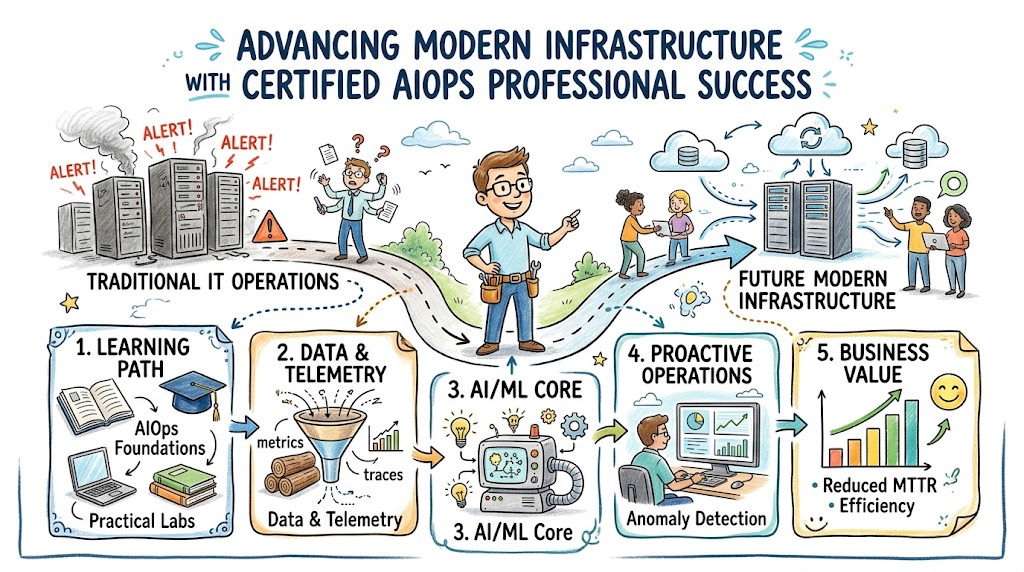
The Certified AIOps Professional designation marks a significant shift in how engineering teams manage complex, distributed systems. As environments scale beyond human capacity, this guide provides a roadmap for SREs and DevOps leaders to integrate machine learning into operational workflows. This certification helps professionals move from reactive troubleshooting to proactive system management. By mastering these principles at AIOpsSchool, engineers ensure their career trajectory aligns with the future of automated, self-healing infrastructure and cognitive operations.
What is the Certified AIOps Professional?
The Certified AIOps Professional program represents the bridge between traditional system administration and data-driven automation. It exists because modern cloud-native environments generate more telemetry data than any human operator can process in real-time. This certification focuses on teaching engineers how to apply algorithmic analysis to logs, metrics, and traces to identify root causes faster.
Furthermore, it emphasizes production-focused learning, moving away from theoretical AI concepts toward practical operational utility. It aligns perfectly with enterprise practices where uptime is critical and manual intervention is a bottleneck. Professionals learn to build systems that utilize pattern recognition to predict failures before they impact the end user.
Who Should Pursue Certified AIOps Professional?
Engineers working in DevOps, Site Reliability Engineering, and Cloud Platform teams will find the most immediate value in this path. It is equally beneficial for security analysts who need to detect anomalies in massive datasets and data engineers building robust pipelines. Beginners looking to enter the high-end automation market and experienced architects aiming to modernize their stacks should consider this credential.
In the global market, and specifically within India’s booming tech hubs, the demand for “intelligent” operations is skyrocketing. Engineering managers and technical leaders also benefit by understanding the capabilities of AIOps to better lead digital transformation initiatives. This certification serves as a universal language for those bridging the gap between development and automated operations.
Why Certified AIOps Professional is Valuable and Beyond
The longevity of a career in tech depends on the ability to stay ahead of the tool-exhaustion curve. While specific software tools come and go, the methodology of using data to drive operational decisions is here to stay. This certification ensures that professionals remain relevant as enterprises move toward “NoOps” and highly autonomous cloud environments.
The return on time investment is substantial because it shifts an engineer’s value from “fixing things” to “building things that fix themselves.” Enterprise adoption of artificial intelligence in IT operations is no longer optional for companies operating at scale. By gaining these skills, you position yourself as a rare talent capable of managing the next generation of cognitive infrastructure.
Certified AIOps Professional Certification Overview
The program is delivered via the official portal and is hosted on AIOpsSchool. It utilizes a practical assessment approach that values hands-on capability over rote memorization of terms. The ownership of the program ensures that the curriculum stays updated with the latest advancements in large-scale monitoring and algorithmic processing.
The structure is broken down into modular segments that cover data ingestion, noise reduction, and automated incident response. It is designed to be accessible yet rigorous, ensuring that anyone who passes has a functional understanding of how to implement AIOps tools. This practical framework allows engineers to immediately apply their learning to existing enterprise production environments.
Certified AIOps Professional Certification Tracks & Levels
The certification is structured to support growth from foundational knowledge to advanced architectural mastery. The foundation level introduces core concepts of telemetry and basic statistical analysis. The professional level dives deep into machine learning models for anomaly detection and event correlation in complex microservices.
Advanced levels focus on the strategic implementation of AIOps across entire organizations, including governance and cost optimization. These tracks are designed to align with career progression, moving from a technical contributor to a specialized lead. By following these levels, an engineer can systematically build a portfolio of skills that matches the complexity of modern enterprise needs.
Complete Certified AIOps Professional Certification Table
| Track | Level | Who it’s for | Prerequisites | Skills Covered | Recommended Order |
| Operations | Foundation | Junior Engineers | Basic Linux/Cloud | Log Analysis, Monitoring | First |
| Engineering | Professional | SREs / DevOps | 2+ Years Experience | ML Models, Anomaly Detection | Second |
| Architecture | Advanced | Tech Leads / Architects | Professional Cert | System Design, Automation | Third |
| Analytics | Specialist | Data Engineers | Python Basics | Telemetry Pipelines | Optional |
Detailed Guide for Each Certified AIOps Professional Certification
Certified AIOps Professional – Foundation
What it is
This certification validates a fundamental understanding of how artificial intelligence enhances standard IT operations. It confirms the candidate’s ability to distinguish between traditional monitoring and modern observability.
Who should take it
Entry-level DevOps engineers, systems administrators, and recent graduates looking to specialize in modern infrastructure management should start here.
Skills you’ll gain
- Understanding telemetry data types (Metrics, Logs, Traces).
- Basic knowledge of event correlation and noise reduction.
- Familiarity with the AIOps lifecycle.
Real-world projects you should be able to do
- Configure a basic monitoring dashboard with automated alerts.
- Perform manual log aggregation and identify recurring patterns.
Preparation plan
- 7–14 days: Focus on core terminology and the difference between AIOps and DevOps.
- 30 days: Explore basic monitoring tools and practice data visualization.
- 60 days: Not typically required for foundation unless the candidate is new to IT.
Common mistakes
- Overcomplicating basic statistical concepts.
- Ignoring the cultural shift required for AIOps adoption.
Best next certification after this
- Same-track option: Certified AIOps Professional – Associate.
- Cross-track option: Cloud Practitioner.
- Leadership option: ITIL Foundation.
Certified AIOps Professional – Professional
What it is
This level validates the ability to implement and manage machine learning models within an operational context. It focuses on reducing “alert fatigue” and improving Mean Time to Recovery (MTTR).
Who should take it
Experienced SREs, DevOps engineers, and Platform engineers who manage large-scale production environments and want to automate incident management.
Skills you’ll gain
- Implementing supervised and unsupervised learning for IT operations.
- Advanced root cause analysis using algorithmic correlation.
- Building automated remediation workflows.
Real-world projects you should be able to do
- Deploy an anomaly detection system on a live Kubernetes cluster.
- Automate the suppression of duplicate alerts across multiple tools.
Preparation plan
- 7–14 days: Review Python for data science and basic ML libraries.
- 30 days: Hands-on labs with event correlation engines.
- 60 days: Full project implementation and practice exams.
Common mistakes
- Relying too heavily on default model settings without tuning.
- Failing to validate data quality before feeding it into models.
Best next certification after this
- Same-track option: Certified AIOps Professional – Expert.
- Cross-track option: MLOps Engineering Certification.
- Leadership option: Technical Program Manager.
Choose Your Learning Path
DevOps Path
The journey starts with integrating automated testing and deployment with basic monitoring. Professionals then move toward using AIOps to predict deployment failures based on historical data. Consequently, the focus shifts from manual pipelines to self-correcting CI/CD workflows that react to production telemetry.
DevSecOps Path
In this path, the emphasis is placed on using anomaly detection to identify security threats in real-time. By applying AIOps, security professionals can distinguish between normal traffic spikes and sophisticated DDoS attacks or data exfiltration. Therefore, the goal is to build an intelligent security perimeter that evolves with the threat landscape.
SRE Path
Reliability is the core focus here, where AIOps is used to manage Error Budgets and Service Level Objectives (SLOs). SREs utilize predictive analytics to forecast potential capacity issues before they lead to outages. Ultimately, this path leads to a state where systems handle routine maintenance and minor failures autonomously.
AIOps Path
This specialized track focuses deeply on the algorithmic side of operations management. Candidates learn to build and maintain the actual data pipelines and ML models that power the IT organization. It is ideal for those who want to be the architects of the company’s internal automation platform.
MLOps Path
While AIOps focuses on using AI for operations, MLOps focuses on the operations of AI. This path teaches engineers how to manage the lifecycle of machine learning models in production, ensuring they don’t drift over time. It bridges the gap between data science teams and infrastructure teams.
DataOps Path
DataOps focuses on the quality and reliability of the data flowing through the organization’s pipelines. By applying AIOps principles, DataOps engineers can automate the monitoring of data health and integrity. This ensures that the downstream analytics and AI models are always working with accurate information.
FinOps Path
Financial operations benefit from AIOps through intelligent cloud cost forecasting and anomaly detection in billing. Engineers learn to identify “runaway” costs in real-time and automate the right-sizing of resources. This results in a leaner, more cost-efficient cloud presence that reacts to usage patterns.
Role → Recommended Certified AIOps Professional Certifications
| Role | Recommended Certifications |
| DevOps Engineer | AIOps Professional, Foundation |
| SRE | AIOps Expert, Professional |
| Platform Engineer | AIOps Professional, Specialist |
| Cloud Engineer | AIOps Foundation, Professional |
| Security Engineer | AIOps Specialist (Security focus) |
| Data Engineer | AIOps Professional, DataOps Specialist |
| FinOps Practitioner | AIOps Foundation, FinOps Specialist |
| Engineering Manager | AIOps Foundation, Leadership Track |
Next Certifications to Take After Certified AIOps Professional
Same Track Progression
Deep specialization involves moving toward the Expert or Architect levels of the AIOps path. This entails mastering the design of custom neural networks for specific operational tasks and leading enterprise-wide automation strategies. It ensures that you remain the go-to authority for high-scale infrastructure logic.
Cross-Track Expansion
Skill broadening often leads engineers toward MLOps or FinOps after mastering AIOps. Since AIOps provides the data foundation, moving into MLOps allows you to manage the entire AI lifecycle. Alternatively, FinOps allows you to apply your analytical skills to the financial health of the organization.
Leadership & Management Track
Transitioning to leadership requires a shift from technical implementation to strategic oversight. Post-AIOps, certifications in technical management or executive leadership help you translate “automation” into “business value.” You will lead teams in choosing the right balance between human intuition and machine intelligence.
Training & Certification Support Providers for Certified AIOps Professional
DevOpsSchool
This provider offers extensive resources for those looking to master the integration of development and operations. Their curriculum covers a wide range of automation tools and methodologies essential for modern engineering. They focus on practical labs that simulate real-world production environments for all students.
Cotocus
This organization specializes in high-end consulting and training for cloud-native technologies and digital transformation. They provide tailored learning paths that help professionals transition into advanced technical roles with ease. Their trainers are industry veterans who bring years of experience to the classroom setting.
Scmgalaxy
As a community-driven platform, this provider offers a wealth of knowledge on software configuration management and CI/CD. They provide a mix of free resources and structured training programs for engineers at all levels. Their focus remains on the practical application of tools in a professional setting.
BestDevOps
This portal focuses on providing curated content and training for the most in-demand DevOps skills in the market. They emphasize a hands-on approach to learning, ensuring that every candidate can implement what they study. Their certification support is designed to help professionals pass exams on their first attempt.
devsecopsschool.com
This institution focuses on the critical intersection of security and DevOps, providing specialized training for security-minded engineers. Their courses cover everything from automated security testing to compliance as code. They aim to make security a seamless part of the development lifecycle for every organization.
sreschool.com
This school is dedicated to the principles of Site Reliability Engineering, focusing on scalability and system reliability. Their training covers the essential pillars of SRE, including monitoring, incident response, and post-mortems. They help engineers build the mindset required to manage global-scale systems effectively.
aiopsschool.com
This is the primary destination for learning about the application of artificial intelligence in IT operations. They offer specialized tracks that range from foundational knowledge to advanced architectural mastery. Their curriculum is updated frequently to reflect the rapidly changing landscape of AI and automation.
dataopsschool.com
This provider focuses on the emerging field of DataOps, teaching engineers how to manage data pipelines with agility. Their training emphasizes data quality, orchestration, and the automation of data workflows. They help organizations turn their data into a reliable asset for decision-making.
finopsschool.com
This school addresses the financial side of cloud computing, teaching professionals how to optimize costs and drive value. Their courses cover cloud billing, resource optimization, and the cultural shift required for effective FinOps. They provide the tools needed to manage cloud spend in a complex environment.
Frequently Asked Questions (General)
- How difficult is the Certified AIOps Professional exam?
The difficulty is moderate to high, as it requires both operational experience and a basic understanding of data science. - What is the recommended study time for a working professional?
Most professionals find that 30 to 60 days of consistent study is sufficient to master the material. - Are there any hard prerequisites for the professional level?
While not always mandatory, having two years of experience in DevOps or SRE is highly recommended. - What is the expected ROI for this certification?
Professionals often see increased salary offers and access to senior-level roles in high-scale tech companies. - Can I take the exam online?
Yes, most providers offer proctored online exams that you can take from the comfort of your home. - How long is the certification valid?
Typically, the certification is valid for two to three years, after which recertification is required to ensure skills are current. - Does this certification cover specific tools like Splunk or ELK?
It focuses on the principles and methodologies, though popular tools are often used in the practical lab sessions. - Is there a focus on coding or programming?
Yes, a basic to intermediate understanding of Python is usually necessary for the professional and advanced levels. - How does AIOps differ from standard automation?
Standard automation follows predefined rules, while AIOps uses machine learning to adapt and make decisions based on data. - Is this certification recognized globally?
Yes, the concepts taught are universal and are valued by multinational corporations across the globe. - Should I learn DevOps before AIOps?
Yes, a strong foundation in DevOps principles makes the transition into AIOps much smoother and more logical. - Are there practice exams available?
Most training providers offer mock exams to help candidates familiarize themselves with the question format and timing.
FAQs on Certified AIOps Professional
- What specific machine learning models are covered in the curriculum?
The program covers regression for forecasting, clustering for event grouping, and classification for identifying specific types of system failures. - How does this certification address alert fatigue in large teams?
It teaches algorithmic noise reduction techniques that filter out insignificant events, allowing teams to focus on critical issues. - Can I apply these skills to on-premises environments?
While cloud-native is a focus, the principles of data-driven operations apply equally to hybrid and legacy on-premises data centers. - What role does Python play in the certification process?
Python is used to build data ingestion scripts and to interact with machine learning libraries during the hands-on labs. - Is there a focus on real-time data processing?
Yes, the certification covers stream processing and real-time telemetry analysis which are vital for modern, fast-paced environments. - Does the course cover the ethics of automated remediation?
The curriculum includes sections on governance and safety to ensure that automated actions do not cause unintended system outages. - How does AIOps help with cloud cost management?
It provides the analytical foundation to identify unused resources and predict future spending patterns based on historical usage. - Is this certification suitable for non-technical managers?
The foundation level is excellent for managers, but the professional level is designed for hands-on technical practitioners.
Final Thoughts: Is Certified AIOps Professional Worth It?
If you are looking at the trajectory of the industry, the move toward data-driven operations is undeniable. Systems are becoming too complex for manual management, and AIOps is the logical solution to this scale. This certification provides the structured learning path needed to transition from a traditional engineer to a modern, AI-augmented professional.
