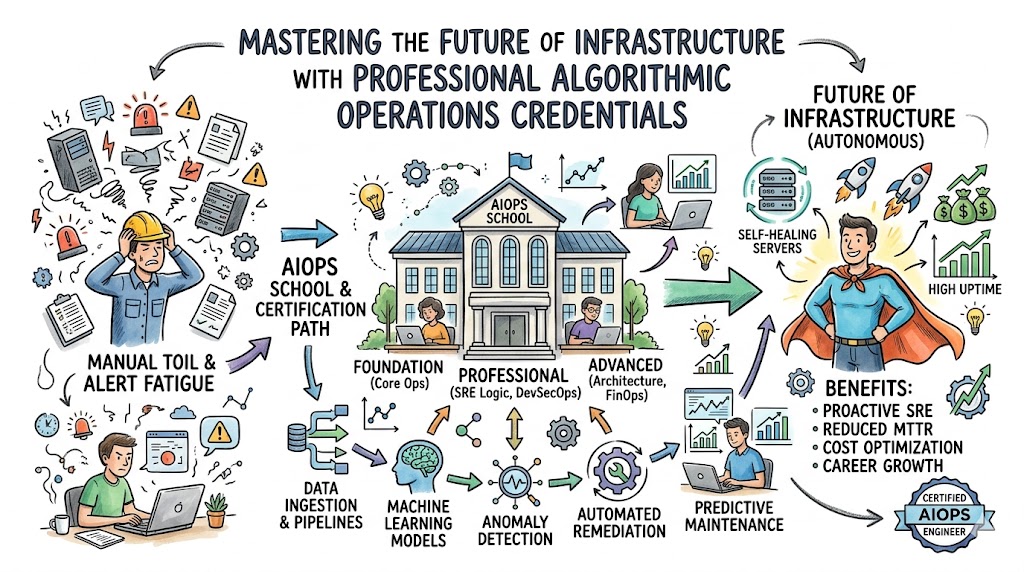
The modern digital landscape demands a shift from manual oversight to intelligent, automated management of complex systems. Engineers who embrace the Certified AIOps Engineer program at AIOpsSchool position themselves at the cutting edge of this evolution. This guide explores how professionals can harness artificial intelligence to predict failures and automate resolution workflows across distributed environments. By following this structured roadmap, technical contributors and leaders gain the clarity needed to choose a learning path that maximizes their professional growth.
What is the Certified AIOps Engineer?
Industry experts designed this credential to validate the practical application of machine learning within IT operations. It exists to replace outdated, rule-based monitoring with dynamic, data-driven systems that can identify anomalies in real-time. The curriculum prioritizes production-grade outcomes over abstract theory, ensuring that graduates can implement self-healing infrastructure in high-pressure enterprise settings. It aligns perfectly with the needs of modern organizations that must scale their services without overwhelming their human operators with alert fatigue.
Who Should Pursue Certified AIOps Engineer?
DevOps practitioners, Site Reliability Engineers, and platform architects looking to modernize their skill set will find this certification indispensable. It also provides significant value to security professionals and data engineers who need to understand how AI influences the reliability and safety of cloud-native stacks. Even engineering managers find the program beneficial for making informed strategic decisions about automation investments. Whether you operate in the fast-paced Indian tech sector or a global enterprise, these skills differentiate you as a forward-thinking technical leader.
Why Certified AIOps Engineer is Valuable and Beyond
Enterprises increasingly rely on algorithmic intelligence to maintain the uptime required for global digital services. Holding this certification proves you can handle the sheer volume of telemetry data that traditional methods simply cannot process. You secure your career longevity by mastering tools and methodologies that remain relevant even as specific vendors or cloud providers evolve. Ultimately, this investment pays off by making you the architect of systems that reduce operational costs while simultaneously improving service reliability.
Certified AIOps Engineer Certification Overview
Professionals access this comprehensive learning journey through the official Certified AIOps Engineer course page, hosted on the AIOpsSchool platform. The program uses a rigorous, hands-on assessment model that requires candidates to solve actual infrastructure problems in a simulated production environment. It offers a clear modular structure, allowing you to progress from core concepts to specialized advanced architectures at your own pace. This ownership model ensures that the training remains strictly aligned with the latest industry shifts and technological breakthroughs.
Certified AIOps Engineer Certification Tracks & Levels
The program offers three distinct tiers—foundation, professional, and advanced—to support engineers at every stage of their career. The foundation level focuses on the basics of data collection and correlation logic, while higher levels dive into complex topics like NLP for log analysis and predictive scaling. You can also choose specialist tracks that align with specific disciplines like security or financial management. This tiered approach ensures that your certification journey directly supports your specific day-to-day job functions and long-term career goals.
Complete Certified AIOps Engineer Certification Table
| Track | Level | Who it’s for | Prerequisites | Skills Covered | Recommended Order |
| Core Ops | Foundation | Junior Engineers | Linux Skills | Metrics & Logs | 1st |
| SRE Logic | Professional | Senior SREs | Python | Anomaly Models | 2nd |
| Architecture | Advanced | Tech Leads | Professional | Scaling AI | 3rd |
| FinOps | Specialist | Cloud Managers | Analysis | Cost Prediction | Optional |
Detailed Guide for Each Certified AIOps Engineer Certification
Certified AIOps Engineer – Foundation Level
What it is
This level validates your grasp of the fundamental concepts behind intelligent operations. It confirms you understand how machine learning enhances standard observability practices.
Who should take it
Junior DevOps engineers and system administrators who want to transition away from manual troubleshooting should start here. It serves as the perfect entry point for anyone new to AI-driven automation.
Skills you’ll gain
- Identification of high-value operational data.
- Basic understanding of correlation algorithms.
- Proficiency in setting up AI-enhanced dashboards.
Real-world projects you should be able to do
- Configure a basic alerting system that filters out duplicate noise.
- Map data flows from multiple microservices into a central AI engine.
Preparation plan
- 7-14 Days: Learn core terminology and data ingestion basics.
- 30 Days: Explore open-source AI tools for monitoring.
- 60 Days: Complete lab exercises focused on event deduplication.
Common mistakes
- Ignoring the importance of clean, consistent data tagging.
- Overcomplicating basic monitoring setups before mastering the fundamentals.
Best next certification after this
- Same-track option: Professional Certified AIOps Engineer.
- Cross-track option: SRE Foundation.
- Leadership option: Team Lead.
Certified AIOps Engineer – Professional Level
What it is
This level proves you can design and maintain production-ready AIOps workflows. It shifts the focus from understanding concepts to implementing real-world, automated remediation systems.
Who should take it
Experienced SREs and platform engineers who hold primary responsibility for system reliability should take this. It is for those ready to lead automation projects.
Skills you’ll gain
- Advanced anomaly detection modeling.
- Implementation of self-healing scripts.
- Root cause analysis using automated trace correlation.
Real-world projects you should be able to do
- Build an automated rollback gate based on AI performance scores.
- Create a predictive capacity planning model for a Kubernetes cluster.
Preparation plan
- 7-14 Days: Deep dive into Python-based data science libraries.
- 30 Days: Practice building models against real-world failure datasets.
- 60 Days: Finalize a complete end-to-end automation architecture.
Common mistakes
- Building “black box” models that the rest of the team cannot understand.
- Failing to set clear thresholds for automated actions.
Best next certification after this
- Same-track option: Advanced AIOps Architect.
- Cross-track option: Certified MLOps Professional.
- Leadership option: Engineering Manager.
Choose Your Learning Path
DevOps Path
Engineers on this path use AI to accelerate the development lifecycle while maintaining strict quality gates. They prioritize automated testing and deployment strategies that rely on predictive analytics to spot issues early. This path ensures that speed never comes at the expense of system stability.
DevSecOps Path
This track integrates intelligent automation into the security pipeline to identify threats that traditional scanners miss. You learn to use machine learning for real-time anomaly detection and automated compliance reporting. It allows security teams to scale as fast as the development teams they support.
SRE Path
The SRE path focuses on maintaining high availability through intelligent forecasting and automated incident response. Engineers learn to manage error budgets more effectively by predicting outages before they occur. This is the most technically intense track, requiring deep work with complex telemetry data.
AIOps Path
This specific track focuses on the foundational infrastructure required to run algorithmic operations at scale. It covers the management of data pipelines and the automation logic needed for autonomous systems. Engineers here become experts in the tools that power the intelligence layer.
MLOps Path
Professionals here focus on the lifecycle of the machine learning models themselves, ensuring they remain accurate over time. You learn to implement versioning and monitoring for ML assets to prevent performance degradation. It bridges the gap between infrastructure and data science.
DataOps Path
AIOps requires high-quality data, and this path teaches you how to orchestrate the pipelines that provide it. You focus on data integrity, governance, and real-time delivery to ensure that the AI models make decisions based on accurate information.
FinOps Path
This specialization applies AI to cloud cost management, helping organizations optimize their spending through predictive analytics. You learn to identify waste and forecast future budget needs with high precision. This role is vital for keeping cloud-based businesses profitable.
Role → Recommended Certified AIOps Engineer Certifications
| Role | Recommended Certifications |
| DevOps Engineer | Foundation + Professional (DevOps) |
| SRE | Professional + Advanced (SRE) |
| Platform Engineer | Professional (AIOps) |
| Cloud Engineer | Foundation + Professional (Cloud) |
| Security Engineer | Professional (DevSecOps) |
| Data Engineer | Professional (DataOps) |
| FinOps Practitioner | Specialist (FinOps) |
| Engineering Manager | Foundation + Leadership Module |
Next Certifications to Take After Certified AIOps Engineer
Same Track Progression
Once you master the advanced levels, you should aim for architectural roles that define the automation strategy for the entire organization. This involves designing global systems that operate with minimal human intervention. You will move from being a practitioner to a strategic visionary.
Cross-Track Expansion
Broadening your knowledge into related fields like MLOps or FinOps makes you a more versatile and valuable professional. Understanding how AI impacts different domains allows you to solve multifaceted problems that simple tool specialists cannot.
Leadership & Management Track
If you enjoy guiding people, transition into technical management where you can justify the business value of AIOps to executives. You will focus on building high-performance teams and creating an organizational culture that trusts and embraces automation.
Training & Certification Support Providers for Certified AIOps Engineer
DevOpsSchool
This provider offers highly practical training modules that focus on the real-world needs of today’s engineering teams. They prioritize hands-on labs and project-based learning to ensure every student can apply their new skills immediately.
Cotocus
Focusing on the enterprise market, this organization helps large teams master the complexities of cloud-native infrastructure. They offer customized training programs that align perfectly with the specific technical challenges faced by global corporations.
Scmgalaxy
As a major community hub, this site provides an incredible library of resources for anyone looking to master configuration management and automation. It is the perfect place for self-driven learners to start their journey into intelligent operations.
BestDevOps
This platform simplifies complex topics like machine learning, making them accessible to engineers from all backgrounds. They offer curated learning paths that guide you step-by-step from basic concepts to professional mastery.
devsecopsschool.com
Engineers who want to lead the charge in automated security turn to this platform for specialized training. They provide the deep technical knowledge required to integrate AI into the modern security stack effectively.
sreschool.com
This site focuses on the core principles of reliability, teaching engineers how to build and maintain stable systems at scale. They treat AIOps as an essential component of the modern SRE toolkit.
aiopsschool.com
As the primary home for the Certified AIOps Engineer program, this site offers the most direct and thorough path to certification. They provide specialized tracks that cater to every major role in the modern IT landscape.
dataopsschool.com
This provider focuses on the data pipelines that serve as the backbone for any successful AIOps strategy. They teach the skills necessary to manage and orchestrate the information flows that fuel intelligent systems.
finopsschool.com
Professionals looking to master the economics of the cloud find the specialized training they need on this platform. They focus on using AI to drive financial efficiency and maximize the value of cloud investments.
Frequently Asked Questions (General)
- How hard is the final certification exam?
The exam presents a fair but rigorous challenge, testing both your conceptual knowledge and your ability to apply that knowledge in practical labs. - How much time should I dedicate to studying each week?
Most successful candidates dedicate between 5 to 10 hours a week, allowing them to finish the course in about two to three months. - Do I need advanced coding skills for the foundation level?
You don’t need to be an expert developer, but a basic comfort level with scripting languages like Python will help you significantly. - Is the certification recognized by major tech companies?
Yes, the program is highly regarded across the industry as it proves a practitioner has hands-on experience with modern automation frameworks. - How long does the certification last?
The credential typically remains valid for two years, after which you can take a brief update exam to keep your status current. - Can I access the course material from a mobile device?
Yes, the learning platform is fully responsive, allowing you to review lessons and theoretical material whenever it is convenient for you. - Does the program focus on specific vendors?
While you will use popular industry tools, the curriculum focuses on vendor-neutral principles that you can apply to any technology stack. - What kind of salary growth can I expect?
AIOps professionals are in high demand and often command salaries that are 20% to 30% higher than traditional DevOps roles. - Is there a community forum for students?
Yes, you gain access to an active community where you can collaborate with peers, ask questions, and share insights. - Do the labs require me to pay for my own cloud resources?
No, the program typically provides the necessary cloud environments and lab instances as part of the enrollment fee. - Can this certification help me move into a management role?
Absolutely, the advanced tracks include strategic modules that help you communicate technical value to business stakeholders. - What happens if I don’t pass the exam?
The platform usually offers a retake option, allowing you to review the specific areas where you struggled and try again.
FAQs on Certified AIOps Engineer
- How does AI change the way we handle on-call shifts?
By automating the initial diagnosis and remediation steps, AI significantly reduces the number of times an engineer is actually paged during the night. - Does this program cover the ethics of automated systems?
Yes, we include discussions on ensuring your automated actions are transparent and do not lead to unintended system consequences. - What is the most popular track for experienced SREs?
Most senior SREs choose the Professional level track, as it focuses directly on the automation of reliability and incident response. - Can I use this certification to work as a freelance consultant?
Yes, the mastery of these advanced automation concepts makes you a highly valuable consultant for companies undergoing digital transformation. - How often is the course content updated?
We update the material every six months to ensure it includes the latest tools and best practices from the AIOps world. - Are there any group discounts for engineering teams?
Yes, many of our training partners offer corporate packages for teams looking to upskill their entire staff together. - Does the course cover Large Language Models?
Recent updates to the advanced tracks now include how to use generative AI to assist with log summarization and script generation. - Is this program suitable for fresh graduates?
Yes, the foundation level is perfectly designed to help new graduates differentiate themselves in a competitive job market.
Final Thoughts
Deciding to master intelligent operations marks a turning point in any engineer’s career path. As the scale of modern infrastructure continues to explode, those who can implement AI-driven automation will lead the industry forward. This certification provides more than just a title; it gives you the practical skills needed to solve the most complex operational challenges of our time. You move from being a reactive troubleshooter to becoming a proactive architect of self-healing systems. Start your journey today and ensure your skills remain indispensable in the era of autonomous infrastructure.
