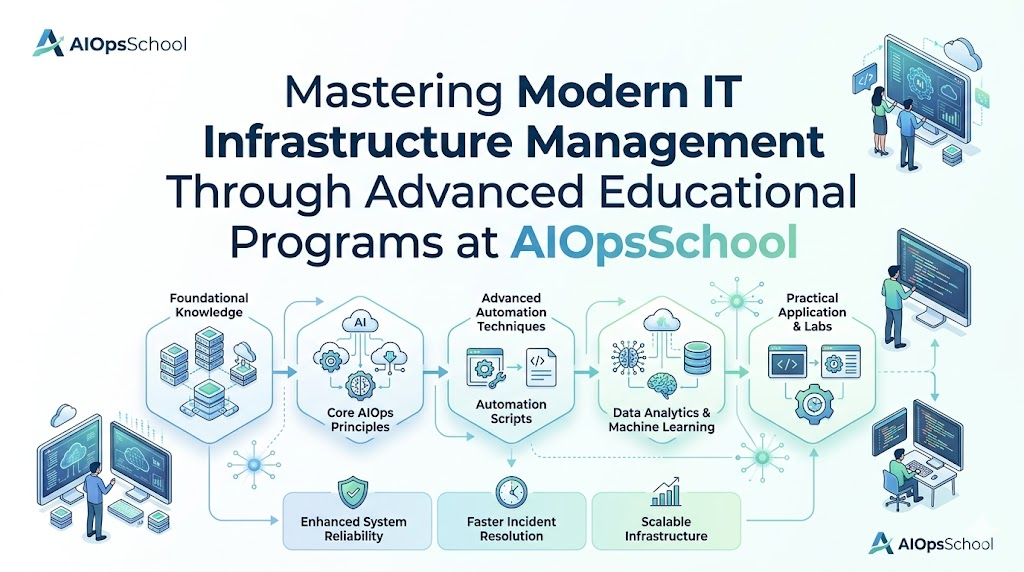
Modern enterprise IT systems handle millions of events every second, leading to massive alert fatigue for engineering teams. Consequently, traditional infrastructure monitoring tools fail to keep pace with microservices, multi-cloud deployments, and distributed architectures. When an outage occurs, engineers face a barrage of disconnected notifications, making isolation of the actual incident nearly impossible. Therefore, organizations urgently need intelligent automation to filter out background noise and precisely identify structural system failures. Selecting a structured educational path like AIOps Training allows systems professionals to transition from manual firefighting to automated, intelligent resilience. Through the specialized educational curriculum available at AiOpsSchool, infrastructure engineers gain the technical competency required to deploy machine learning models directly into production environments.
What Is AIOps?
Artificial Intelligence for IT Operations, commonly known as AIOps, combines big data, machine learning, and advanced analytics to automate enterprise infrastructure management. Essentially, What is AIOps can be summarized as the application of machine learning algorithms to continuous operational telemetry data. Instead of relying on static, hard-coded rules that trigger alerts during minor fluctuations, artificial intelligence dynamically evaluates infrastructure performance. Consequently, the platform absorbs historical patterns, understands contextual baselines, and flags true anomalies before users notice degradation. It serves as an intelligent layer that sits above your entire software ecosystem, continuously ingesting data to provide clarity.
Key Operational Concepts You Must Know
To successfully establish AIOps in IT operations, engineering teams must master several foundational building blocks. First, observability forms the core foundation by ensuring that internal system states can be inferred completely from external outputs. Next, telemetry functions as the continuous stream of raw operational data divided into three essential pillars: logs, metrics, and traces. Specifically, logs document unique discrete events, metrics track numerical resource utilization over time, and distributed traces map the end-to-end journey of a request through microservices.
Furthermore, event correlation acts as the primary logical engine that bundles thousands of isolated notifications into a single cohesive incident group. Machine learning models achieve this by analyzing timestamp proximity, topological relationships, and historical metadata. Simultaneously, the system constantly distinguishes between a normal operational baseline and an actual anomaly. While a standard static threshold might trigger an alert during a predictable midday traffic spike, an intelligent algorithm recognizes this pattern as normal behavior. Finally, automated remediation completes the operational cycle by automatically executing predefined scripts or playbooks to resolve verified incidents without human intervention.
AIOps for Beginners
Entering this field during the current technological shift offers unprecedented advantages for aspiring infrastructure engineers. Mastering AIOps for beginners provides a highly lucrative career trajectory because organizations rapidly abandon legacy monitoring frameworks.
- Exponential Telemetry Growth: Modern cloud-native software generates too much operational telemetry data for manual human analysis, rendering legacy alerting systems completely obsolete.
- Proactive Operational Shift: Organizations are aggressively moving from reactive incident firefighting to proactive failure prevention models to eliminate costly corporate downtime.
- Critical Talent Shortage: The technology market faces an acute shortage of systems engineers who possess deep machine learning and automated remediation expertise.
AIOps vs DevOps vs MLOps
Understanding how this discipline relates to other modern engineering methodologies clarifies its unique value within the corporate technology stack. Specifically, AIOps vs DevOps highlights the shift from code delivery pipelines to intelligent live system maintenance. Similarly, comparing AIOps vs MLOps differentiates between applying machine learning to operations versus managing the lifecycle of machine learning models themselves.
| Concept | Primary Focus | Core Question It Answers |
| DevOps | Accelerating software delivery lifecycles through continuous integration pipelines and infrastructure as code. | How can engineering teams deploy high-quality software features to production rapidly and reliably? |
| MLOps | Standardizing the deployment, versioning, monitoring, and packaging of corporate machine learning models. | How can data science teams efficiently manage machine learning pipelines across production systems? |
| AIOps | Utilizing artificial intelligence to automate incident detection, correlation, and resolution within live environments. | How can automated algorithms optimize infrastructure health and resolve system incidents independently? |
Platform Implementation vs. Culture — What’s the Real Difference?
Many enterprise leaders mistakenly view artificial intelligence as a simple software package that an organization can buy and install overnight. However, successful scaling requires a profound cultural transformation alongside technological adoption. While comprehensive AIOps Training provides engineers with tools, teams must simultaneously build mutual trust in algorithmic decision-making. If your operations center continuously overrides automated recommendations or ignores auto-remediation playbooks, the platform provides zero practical value.
Consequently, embedding AIOps in IT operations demands rigorous change management, cross-team collaboration, and data-driven trust frameworks. Engineers must shift away from siloed component ownership and embrace collective, system-wide algorithmic insights. Ultimately, the true challenge lies not in configuring the software platform itself, but in cultivating the daily operational habits required to act confidently on automated machine learning outputs.
| Dimension | Platform Implementation | Cultural Transformation |
| Primary Objective | Deploying software, connecting telemetry feeds, and configuring ingestion APIs. | Overcoming organizational resistance, breaking down data siloes, and trusting automation. |
| Execution Risk | Misconfigured data models, API connectivity issues, and improper data ingestion. | Continuous manual overriding of algorithmic alerts and lack of operational adoption. |
| Long-term Value | Provides the basic technical mechanics to gather and analyze continuous infrastructure telemetry. | Enables autonomous operational workflows and minimizes human dependency during critical failures. |
Core AIOps Use Cases
Implementing advanced machine learning algorithms within production environments unlocks powerful capabilities for modern systems teams. The most critical AIOps use cases actively transforming current engineering workflows include:
- Dynamic Anomaly Detection: Machine learning algorithms continuously analyze live stream metrics to isolate unusual system behavior without relying on static thresholds.
- Intelligent Event Correlation: The software automatically aggregates thousands of disparate alerts into a single actionable incident based on topological relationships.
- Advanced AIOps root cause analysis: The system traces fault vectors across complex multi-cloud ecosystems to identify the exact trigger of an operational incident immediately.
- Predictive Capacity Planning: Deep learning models evaluate historical storage, compute, and network consumption to forecast future enterprise infrastructure requirements precisely.
- Automated Incident Remediation: The platform independently triggers self-healing workflows, such as restarting failing containers or flushing memory caches, without human intervention.
- Optimized AIOps in IT operations: Systems teams leverage comprehensive automated insights to streamline routine maintenance tasks and maximize overall environment uptime.
Real-World Use Cases of Modern Operations
Global organizations rely on these automated workflows to maintain critical application availability during sudden, unpredictable infrastructure disruptions. For instance, a multinational e-commerce enterprise utilizes real-world AIOps use cases to automatically mitigate sudden database latency spikes during high-traffic holiday shopping events. Concurrently, a premier retail banking institution processes telemetry streams via AIOps in IT operations to instantly isolate and block distributed credential-stuffing attacks before customer transactions fail. Additionally, a prominent enterprise SaaS provider relies on predictive algorithms to forecast cloud compute exhaustion, seamlessly provisioning auto-scaled clusters hours before a localized capacity shortage impacts active users.
AIOps Tools You Should Know
Building a resilient digital enterprise requires deep familiarity with the leading vendor utilities and open-source packages available in the market. Reviewing an enterprise AIOps tools list helps engineering teams select the appropriate software combinations for their specific structural architectures. Navigating an interactive AIOps Tutorial provides the foundational practical experience necessary to deploy and manage these diverse AIOps Tools effectively.
- Monitoring and Observability Platforms
- Datadog Watchdog: Delivers automated anomaly detection and root cause scoping natively across full-stack application telemetry.
- Dynatrace Davis: Utilizes a deterministic AI engine to evaluate dependencies and pinpoint precise fault impact vectors.
- New Relic AI: Aggregates scattered infrastructure telemetry data to reduce alerting noise significantly for on-call engineers.
- Splunk IT Service Intelligence: Translates complex machine data into real-time business service health scores and predictive warnings.
- Event Correlation and ITSM Tools
- BigPanda: Consolidates massive volumes of operational alerts into clear, context-rich incidents through Open Integration Hubs.
- PagerDuty Operations Cloud: Leverages historical event data to automate triage pathways and accelerate incident responder assignments.
- ServiceNow ITOM: Aligns infrastructure configuration items with automated workflows to streamline enterprise change management tracking.
- Open-Source Stacks and Cloud-Native Services
- Prometheus and Cortex: Provides scalable, long-term metric storage coupled with basic statistical anomaly thresholding capabilities.
- Elastic Stack (ELK) Machine Learning: Uncovers hidden log data anomalies using unsupervised clustering algorithms.
- AWS DevOps Guru: Analyzes cloud-native application footprints to deliver prescriptive remediation recommendations automatically.
Common Mistakes in Operations Engineering
Deploying machine learning models into complex production ecosystems without a structured strategy frequently leads to project abandonment. Specifically, failing to establish rigorous operational standards diminishes the overall effectiveness of AIOps in IT operations.
- Neglecting Continuous Noise Reduction: Teams frequently configure too many uncoordinated telemetry sources, which creates massive alert fatigue instead of clearing operational visibility. Fix: Implement strict initial aggregation filters to ensure only high-severity incidents reach on-call engineers.
- Treating Platforms as Set-and-Forget Systems: Operators regularly assume that machine learning algorithms require zero ongoing calibration or baseline adjustments over time. Fix: Establish monthly review cycles to retrain analytical models against recent architectural updates.
- Ignoring Telemetry Data Quality: Enterprises often feed unstructured, poorly formatted logs directly into machine learning engines without initial sanitization. Fix: Standardize all distributed trace schemas and log formats using OpenTelemetry frameworks before ingestion.
- Automating Critical Remediation Prematurely: Engineers sometimes connect destructive self-healing scripts to unverified alerts before establishing model accuracy thresholds. Fix: Require manual human approval for all automated actions during the first ninety days of deployment.
- Failing to Secure Multi-Department Buy-In: System administrators frequently deploy platform updates without educating neighboring application development groups. Fix: Conduct cross-functional workshops to demonstrate how unified algorithmic insights benefit all engineering teams.
Consequently, resolving these foundational mistakes accelerates AIOps root cause analysis efficiency and fosters long-term institutional trust in autonomous operations.
AIOps for SRE
Site Reliability Engineers depend heavily on automated analytics to defend strict user performance agreements in highly volatile environments. Incorporating AIOps for SRE fundamentally shifts how teams calculate service level indicators and manage error budgets. Traditionally, engineers spend hours manually querying distributed logs to discover why an application breaches its target Service Level Objectives (SLOs).
By automating telemetry synthesis, machine learning engines dramatically compress the Mean Time to Detection (MTTD) from hours to fractional seconds. Furthermore, when an incident occurs, automated root-cause mapping shortens the Mean Time to Resolution (MTTR) by triggering instantaneous self-healing playbooks. Consequently, engineering teams safely preserve their error budgets, lower operational stress, and dedicate more time to building resilient infrastructure features.
Seeing AIOps in Action
Consider a severe real-world production incident within a major microservices application to understand the true impact of automated management.
The Problem
During a routine mid-day software deployment, a localized memory leak occurs within an underlying payment processing microservice. Consequently, the containerized application consumes available memory, causing transaction response latencies to climb. Traditional monitoring tools trigger hundreds of separate alerts across network interfaces, database clusters, and web servers, completely blinding the operations team.
The Algorithmic Resolution
Instead of routing every notification to human operators, the enterprise analytics engine intercepts the raw telemetry stream.
- Ingestion: The system continually processes incoming metrics, logs, and distributed traces from the entire application ecosystem.
- Correlation: It automatically groups two hundred related notifications into a single incident based on the live system topology map.
- Isolation: Utilizing AIOps root cause analysis, the platform identifies the exact payment microservice container causing the latency spike.
- Remediation: The engine automatically initiates an pre-approved self-healing playbook that isolates the broken container and rolls back the deployment.
The Measurable Result
Through the intelligent application of AIOps in IT operations, the enterprise isolates and resolves the incident in under three minutes. This saves the corporation thousands of dollars in potential transaction downtime while entirely shielding human operators from alert fatigue.
How to Become an Operations Expert — Career Roadmap
Navigating the transition toward autonomous infrastructure management requires a structured educational strategy and hands-on technical validation.
- Master Systems Engineering Fundamentals: Establish a rock-solid understanding of core linux administration, cloud architecture, and networking protocols.
- Develop Observability Expertise: Learn to configure advanced telemetry collection networks using tools like Prometheus, Grafana, and OpenTelemetry standards.
- Acquire Specialized Training: Complete a structured, comprehensive AIOps Training program to master data science applications within live enterprise environments.
- Enroll in a Technical Course: Join a targeted AIOps Course to gain hands-on experience building custom auto-remediation playbooks and incident correlation engines.
- Earn Industry Certification: Validate your advanced engineering capabilities globally by securing an official, recognized AIOps Certification.
Frequently Asked Questions
- What prerequisites are required before starting a professional AIOps Course?Students should possess a solid foundational background in cloud computing infrastructure, basic Linux systems administration, and fundamental script programming. Familiarity with standard DevOps principles and containerization technologies like Kubernetes will also greatly accelerate your learning journey throughout the program.
- How does an official AIOps Certification enhance my professional engineering career?Earning an AIOps Certification provides instant verification of your technical capacity to design, deploy, and manage machine learning operations workflows. Consequently, certified professionals secure much higher salary leverage and stand out significantly to global enterprises hiring for advanced SRE roles.
- What core skills are covered within the AIOps Foundation Certification syllabus?The AIOps Foundation Certification focuses heavily on establishing core operational literacy across telemetry ingestion, event correlation, and anomaly detection models. Furthermore, students learn how to properly integrate machine learning engines into legacy enterprise service management frameworks.
- Can traditional systems administrators transition into this field without data science degrees?Yes, traditional engineers can easily transition by focusing on the practical application of pre-built machine learning models rather than pure theoretical statistics. Completing a structured educational curriculum gives you the exact skills needed to apply these models to live infrastructure environments.
- Why should an enterprise prioritize structured training over self-taught platform experimentation?Enrolling engineering departments in coordinated training ensures that all teams adopt unified architectural standards and shared operational vocabularies. This collective alignment minimizes expensive implementation mistakes, accelerates platform deployment timelines, and ensures much faster returns on software investments.
- What is the typical timeframe required to complete a comprehensive certification program?Most dedicated engineering professionals successfully complete the comprehensive curriculum and pass their technical examinations within six to eight weeks. However, our flexible, self-paced learning structures allow students to balance their studies alongside full-time operational responsibilities.
- How do automated remediation engines ensure safety when executing scripts in production?Automated platforms enforce strict safety guidelines by executing commands within clearly defined logic boundaries and checking model confidence levels. Additionally, teams configure manual approval gates for complex structural changes, ensuring human operators retain ultimate authority over critical systems.
Why Get an AIOps Certification?
Enrolling in a formal validation program serves as a powerful catalyst for professional advancement in the modern technology sector. Securing an official AIOps Certification proves that an engineer can manage complex cloud ecosystems using data-driven methodologies. It demonstrates to prospective employers that you possess both theoretical knowledge and the practical skills required to deploy autonomous monitoring platforms.
Furthermore, preparing for the AIOps Foundation Certification forces professionals to study structural infrastructure engineering systematically. This rigorous training ensures you do not simply learn how to navigate a single software vendor interface. Instead, you master universal algorithmic principles, preparing you to lead complex infrastructure modernization initiatives across any enterprise cloud environment.
Where to Learn AIOps
Acquiring the specialized skills necessary to manage modern autonomous systems demands an educational curriculum designed by industry experts.
- Comprehensive AIOps Training: Master advanced system concepts, telemetry engineering, and algorithmic incident management through structured, expert-led modules.
- Deep-Dive AIOps Course: Gain extensive hands-on experience configuring live event correlation engines, anomaly detection models, and automated self-healing playbooks.
- Global AIOps Certification: Validate your technical infrastructure engineering expertise and boost your professional credibility with an industry-recognized credential.
- Interactive AIOps Tutorial: Learn the step-by-step mechanics of connecting live data pipelines to leading machine learning observability platforms.
Aspiring engineering professionals can access all of these specialized educational resources through the unified curriculum at AiOpsSchool.
Final Thoughts
Transitioning to automated operations is no longer a luxury for modern enterprises; it has become an absolute operational necessity. Enrolling in structured AIOps Training empowers engineers to eliminate manual workflows and master proactive system management. Furthermore, earning a respected AIOps Certification validates your ability to lead complex corporate digital transformations. Discover how to elevate your engineering career and master modern cloud automation by exploring the educational tracks at AiOpsSchool.com.
