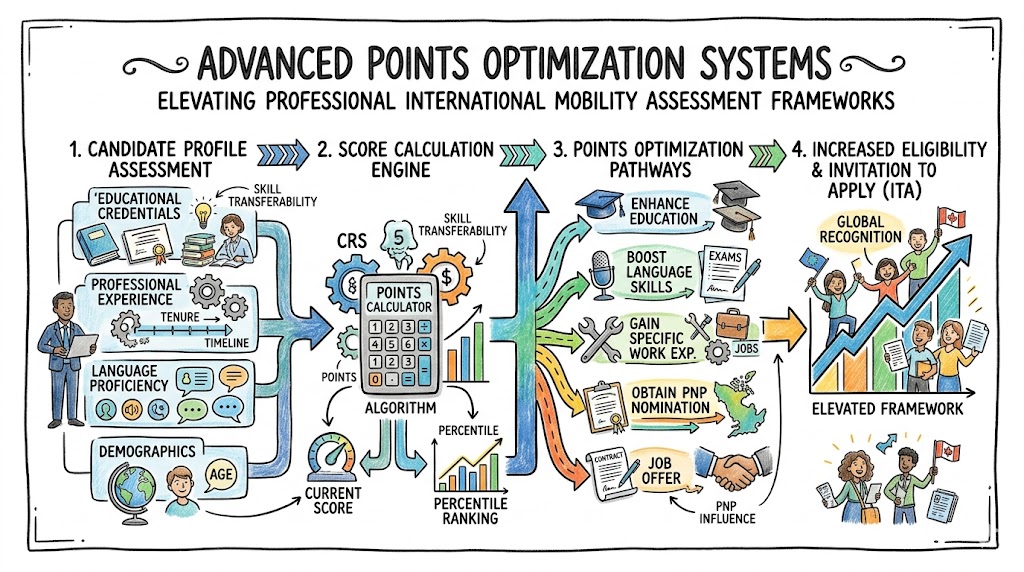
Moving across global borders requires deliberate strategy and absolute precision. Millions of professionals dream of building a stable future in a welcoming economic powerhouse, yet complex regulatory frameworks often block their progress. Navigating these paths feels like decoding an intricate puzzle without a clear diagram. Fortunately, utilizing a Canada PR CRS Calculator simplifies this journey, transforming a confusing process into a predictable roadmap. This technical analysis provides clarity and strategic actionable insights.
What Is a Canada PR CRS Calculator?
The Core Purpose of Canada PR CRS Calculator
A Canada PR CRS Calculator serves as an essential analytical diagnostic platform. It translates an applicant’s lifetime personal and professional milestones into a standardized mathematical value. This tool explicitly measures an applicant’s potential to integrate smoothly into the national workforce. Instead of leaving eligibility to subjective human assessment, this tool establishes a transparent baseline for all applicants globally. It removes speculation, giving users a clear view of their competitive ranking.
How the Canada PR CRS Calculator System Works
The system processes user credentials through a multi-factor mathematical matrix. It evaluates primary personal attributes, including language skills, education, and professional background. The algorithm calculates points systematically up to a maximum threshold of twelve hundred points. As candidates input their data, the system instantly aggregates scores across core categories. This real-time analysis lets prospective immigrants adjust their parameters and see exactly how minor profile changes impact their overall ranking.
Eligibility Standards vs. Selection Criteria
Prospective candidates must understand the clear distinction between basic eligibility standards and competitive selection criteria. Meeting basic eligibility merely grants access into the electronic candidate pool. It guarantees nothing beyond entry. Conversely, selection criteria determine the actual selection from that pool based on current market demands. A candidate might fulfill the minimum entry benchmarks easily, but they still need to maximize their selection parameters to secure an invitation.
Canada PR CRS Calculator Components: The Building Blocks
Age Factors in Canada PR CRS Calculator
Age plays a major role within the point-allocation algorithm. The system heavily rewards candidates who arrive during their peak professional years. Maximum point accumulation occurs between the ages of twenty and twenty-nine. Once a candidate reaches their thirtieth birthday, the system decreases allocation points gradually each year. This sliding scale underlines the critical importance of early strategic planning and prompt application submissions.
Educational Evaluation for Canada PR CRS Calculator
Academic achievements require official verification through authorized assessment bodies before the system recognizes them. The algorithm scales rewards based on the depth and complexity of your credentials. For example, a master’s degree or professional qualification yields far more points than a standard three-year bachelor’s degree. Furthermore, completing multiple post-secondary programs unlocks valuable bonus points within the calculation matrix.
Performance Standards and Benchmarks
Language proficiency acts as a major pillar within the evaluation framework. Candidates must prove their abilities in official languages through approved examinations. The scoring matrix evaluates four specific modules: speaking, listening, reading, and writing. Achieving a high benchmark tier radically boosts your profile score. It also acts as a key multiplier when combined with work experience and education.
Professional Experience Verification
The system assesses employment history based on specialized skill classifications and duration. Continuous full-time professional experience inside or outside the country yields significant points. The validation process requires clear documentation, matching duties to official economic occupational codes. Gaps in employment or poorly documented duties can lead to point reductions or immediate application rejection.
Primary Frameworks Governing Canada PR CRS Calculator
The Detailed Score Breakdown
The overall distribution system divides the twelve hundred points into transparent, manageable categories. The core human capital component accounts for up to five hundred points for single applicants. Spousal factors, skill transferability combinations, and additional bonus qualifications comprise the remaining seven hundred points. This structured approach ensures a comprehensive, balanced evaluation of every candidate profile.
| Category Component | Maximum Points (Single) | Maximum Points (With Spouse) |
| Core Human Capital Factors | 500 | 460 |
| Spouse or Common-Law Partner | 0 | 40 |
| Skill Transferability Multipliers | 100 | 100 |
| Additional Bonus Qualifications | 600 | 600 |
| Total Available System Points | 1,200 | 1,200 |
Real-World Application Scenarios
The calculation matrix performs dynamically when balancing different candidate profiles. For instance, an applicant with a bachelor’s degree and perfect language scores often ranks equally with a master’s graduate who has lower language marks. This equilibrium demonstrates the system’s flexibility. It allows candidates to offset weaknesses in one area by refining and maximizing performance in another.
International Pathways for Canada PR CRS Calculator
Key Categories and Classes
The overarching framework contains specialized entry pathways designed for distinct professional groups. The federal skilled worker stream targets highly educated international professionals. The federal skilled trades pathway serves experienced technical and vocational specialists. Finally, the experiential class provides an accelerated route for individuals who possess local professional or academic experience.
Comparative Results Summary
Different selection streams demand varied point thresholds based on specific economic priorities. General selection draws usually require higher competitive scores due to the large volume of candidates in the pool. Meanwhile, targeted category draws focus on specific in-demand sectors like healthcare, technology, and engineering. These targeted draws often select candidates with lower overall scores, prioritizing specific technical skills over general human capital points.
Advanced Regional Requirements for Canada PR CRS Calculator
Regional sub-programs operate alongside the main federal selection system to address specific local labor shortages. Independent regional governments manage these tailored streams, applying unique selection criteria and priority occupational lists. Securing a local nomination grants an immediate six-hundred-point boost inside the federal database, virtually guaranteeing selection.
These regional variations require candidates to study specific local job markets carefully. A professional code that faces low demand nationally might be highly sought after in a specific province or territory. Additionally, several regional programs require formal local community connections or a valid local job offer before issuing an invitation.
The Global Landscape of Canada PR CRS Calculator
Point-based immigration frameworks are a proven global standard for managing economic migration. Major developed economies utilize similar mathematical models to evaluate and select international talent. While specific metrics vary by country, the fundamental focus remains identical: identifying highly skilled individuals who can contribute immediately to national economic growth.
- The Australian System: Focuses heavily on regional sponsorship, specific age brackets, and strict vocational occupation lists.
- The New Zealand Framework: Prioritizes qualified local employment offers and high-level professional registrations.
- The United Kingdom Structure: Utilizes a mandatory baseline points threshold driven by specific salary baselines and language skills.
- The European Blue Card Program: Couples academic credentials directly with high-value local employment contracts.
Benefits of Utilizing a Canada PR CRS Calculator
Cost Efficiency
Deploying an analytical tool before submitting documents saves thousands of dollars in unnecessary processing fees. Candidates avoid investing heavily in language tests, credential assessments, and translation services if their initial profile falls far short of competitive thresholds. This upfront clarity allows individuals to budget resources intelligently and make data-driven decisions.
Instant Reality Checks
The calculator delivers immediate feedback on an applicant’s global competitive standing. Instead of waiting months for an official evaluation, candidates receive an instant realistic baseline within minutes. This rapid assessment clarifies where a profile stands relative to recent selection trends, injecting transparency into a complex immigration journey.
Strategic Long-Term Planning
Using a digital scoring matrix allows candidates to map out clear optimization paths. Users can test different hypothetical scenarios, such as completing a new language exam or gaining another year of work experience. This capability transforms a static application into a dynamic, long-term career roadmap.
Step-by-Step Guide to Mastering Canada PR CRS Calculator
1. Gathering Necessary Documents
Begin by collecting verified baseline information. You must secure official language test score reports and formal educational credential assessments. Do not guess your data points, as minor discrepancies between your estimated profile and your final official documents can invalidate your entire application.
2. Practicing the Core Assessments
Language proficiency requires deliberate preparation and practice. Dedicate time to understanding the exact structures of approved language examinations. Maximizing your language marks remains the fastest, most controllable method to elevate your overall score.
3. Checking Market Demand Lists
Analyze current occupational demand trends across different economic sectors. Align your specific professional background with the standard occupational classifications utilized by immigration authorities. Identifying the correct technical codes ensures accurate tracking during selection draws.
4. Adding Secondary Factors
Evaluate the potential impact of secondary profile elements. These include a spouse’s educational credentials, their language proficiency scores, or your own local family connections. Combining these secondary elements frequently provides the critical points boost needed to surpass selection thresholds.
5. Calculating the Final Result
Input your verified parameters into the diagnostic system to establish your final competitive score. Monitor selection patterns continuously to determine the best timing for your formal submission into the candidate pool.
Strategies to Optimize Your Canada PR CRS Calculator Score
The Performance Enhancement Strategy
Retaking language examinations represents the most efficient way to maximize a candidate score. Moving up a single tier on the official language scale unlocks substantial core points and activates powerful skill transferability multipliers. Small investments in language prep often yield massive score increases.
Bonus Qualification Advantages
Learning a secondary official language provides a major competitive edge. The system awards generous bonus points to bilingual candidates, regardless of their primary language choice. Furthermore, completing short-term, post-secondary academic programs can open up new point combinations.
Specialized Opportunity Pathways
Securing a verified local job offer or a regional nomination remains the ultimate score optimizer. A valid job offer provides up to two hundred points, while a regional nomination delivers six hundred points. These targeted pathways instantly push an applicant to the top of the competitive pool.
Common Mistakes in the Canada PR CRS Calculator Process
Many applicants overestimate their profile credentials by misinterpreting complex evaluation criteria. A common error involves claiming maximum points for work experience without holding the required supporting documentation, such as detailed employment reference letters. Authorities verify every single claim rigorously, and unproven points cause immediate application refusals.
Another frequent mistake involves using expired language test results or outdated credential assessments. Language test reports carry strict validity limits, typically expiring after two years. Submitting an application with expired documents invalidates your profile and can lead to bans for misrepresentation. Selecting the wrong occupational classification code also derails many applications, as your documented job duties must match the official classification precisely.
Real-Life Case Scenarios Using Canada PR CRS Calculator
The Early Career Scenario
A twenty-six-year-old software engineer holds a bachelor’s degree and boasts three years of international work experience. They secure high language scores but lack local work or study experience. By inputting their metrics into the system, they discover they sit just below the general selection threshold. They decide to pursue a regional nomination program, which quickly secures them an invitation.
The Experienced Professional Scenario
A thirty-eight-year-old project manager holds a master’s degree and has over eight years of professional experience. Although their age reduces their points in that specific category, their high educational credentials and exceptional language scores offset the drop. By maximizing their language points, they maintain a highly competitive position and successfully secure an invitation.
The Specialized Hero Scenario
A thirty-two-year-old mechanical technician holds a two-year vocational diploma and has four years of experience. Their general score is modest, but their specific occupation faces critical nationwide shortages. When a targeted category draw focuses directly on trade professionals, the system selects their profile, proving that specialized skills can outweigh a lower general score.
Frequently Asked Questions (FAQs)
- How long do official language test results remain valid for point calculations?Official language test results remain valid for exactly two years from the test date, and they must be valid when you submit your formal application.
- Can a candidate update their selection profile after entering the pool?Yes, candidates can update their profiles at any time to reflect new language scores, higher education credentials, or changes in work experience.
- Does the scoring system reward part-time work experience?The system calculates part-time work experience on a pro-rata basis, matching the total accumulated hours to the requirement of full-time work.
- What happens if an applicant turns thirty while sitting in the candidate pool?The calculation algorithm updates automatically, reducing the candidate’s age points systematically on their birthday and adjusting their total score.
- Is an educational credential assessment mandatory for international degrees?Yes, you must secure an official educational credential assessment from an authorized body to claim points for international academic degrees.
- Do siblings living locally provide any benefits to the overall calculation score?Yes, having a biological or adopted sibling who is a citizen or permanent resident living locally adds valuable bonus points to your profile.
- Can an applicant claim points for work experience gained during full-time studies?The rules vary by stream; international students generally cannot claim points for local work experience gained during full-time co-op placements.
- What is the maximum point contribution an applicant can receive from a spouse?A spouse can contribute up to forty points through their independent language skills, educational credentials, and local work experience.
- Does a valid job offer guarantee an immediate invitation to apply?A valid job offer adds significant bonus points to your total score, but you must still clear the overall selection threshold for that specific draw.
- How often do immigration authorities execute selection draws from the candidate pool?Authorities execute selection draws regularly, typically every two weeks, though schedules adapt dynamically based on changing economic priorities and targets.
- Can a candidate decline an invitation to apply if their profile data changes?Yes, candidates can decline an invitation within the designated response window, returning their profile safely to the pool for future consideration.
- Does the point system penalize applicants who do not have a local job offer?No, the system does not penalize profiles without job offers; thousands of highly skilled candidates receive invitations based entirely on their core human capital assets.
Conclusion
Navigating international immigration systems demands absolute precision, data-driven strategy, and realistic planning. Utilizing a digital evaluation framework allows prospective immigrants to demystify complex point algorithms and build a dependable roadmap. While changing selection thresholds and shifting economic priorities present challenges, maximizing key elements like language proficiency and regional pathways keeps your profile highly competitive. Commit to systematic profile optimization, track processing trends closely, and take control of your global professional future with confidence.
