Introduction
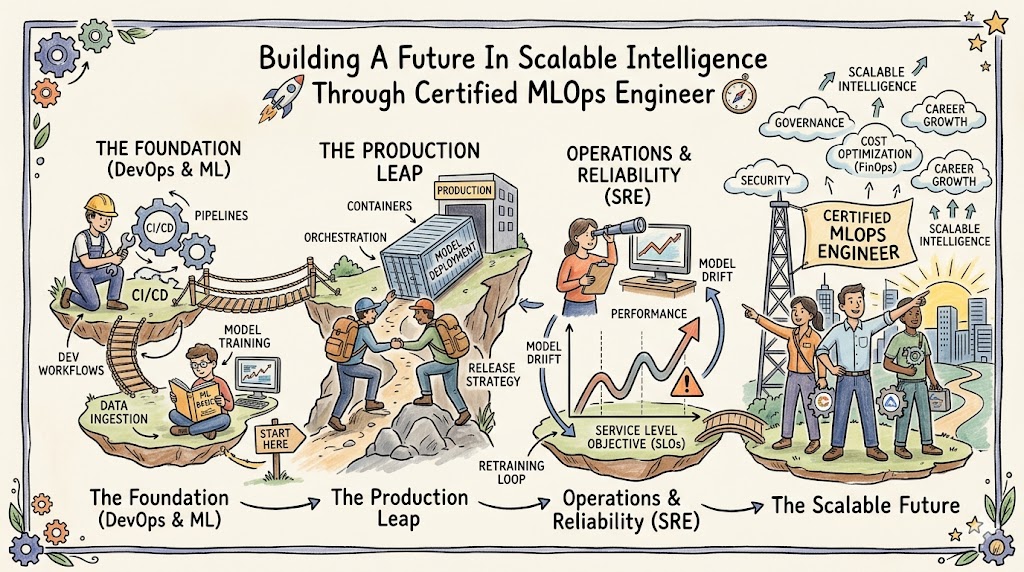
Modern engineering teams increasingly require professionals who bridge the gap between machine learning research and stable production environments. The Certified MLOps Engineer program offers a rigorous framework for mastering these complex intersections of code, data, and infrastructure. This guide assists software architects and system administrators in evaluating how this specialized training accelerates their career trajectory in a competitive market. By following this roadmap, AIOpsSchool helps technical leaders implement scalable, automated intelligence that drives real business value.
What is the Certified MLOps Engineer?
This credential validates an engineer’s ability to operationalize machine learning models through robust, automated delivery pipelines. It represents a shift from manual model experimentation to a professionalized, industrial-scale approach to artificial intelligence. Practitioners learn to treat models as high-velocity software artifacts, ensuring reliability through every stage of the lifecycle. The program aligns with contemporary enterprise needs for resilient, self-healing infrastructure that supports sophisticated data science workloads.
Who Should Pursue Certified MLOps Engineer?
Cloud architects and DevOps specialists seeking to modernize their skill set will find immense value in this curriculum. Data engineers who wish to understand the operational rigors of high-availability systems also benefit from this structured learning path. The program serves both aspiring engineers in India and seasoned global professionals looking to lead technical departments. Even engineering managers gain the necessary oversight to build and supervise cross-functional teams that deliver intelligent applications.
Why Certified MLOps Engineer is Valuable and Beyond
Organizations across the globe are moving past the pilot phase of AI, creating a massive demand for engineers who can manage model drift and automated retraining. This certification provides long-term career security by focusing on the core principles of reliability and scalability rather than temporary software trends. Mastering these workflows ensures that a professional remains relevant as companies increasingly integrate intelligence into their core infrastructure. The investment yields high returns through increased architectural authority and access to premium roles in the technology sector.
Certified MLOps Engineer Certification Overview
Candidates access the learning modules via the official training platform and complete the program through the hosting site. The certification process emphasizes practical competence, requiring participants to demonstrate their skills in live, simulated production environments. It follows a modular structure that covers data governance, model versioning, and continuous monitoring strategies. This ownership model ensures that every certified individual possesses the hands-on experience required to handle enterprise-level challenges.
Certified MLOps Engineer Certification Tracks & Levels
The curriculum breaks down into foundation, professional, and advanced tiers to accommodate various levels of industry experience. Specialist tracks allow for deep dives into areas like security-focused deployments or cost-optimization for large-scale models. These tiers mirror the natural progression of a technical career, moving from individual task automation to complex system design. By completing these tracks, engineers build a comprehensive portfolio that proves their readiness for senior-level responsibilities.
Complete Certified MLOps Engineer Certification Table
| Track | Level | Who it’s for | Prerequisites | Skills Covered | Recommended Order |
| Operations | Foundation | Junior DevOps | Basic Python | ML Pipelines, Containers | First |
| Engineering | Professional | Mid-level SRE | 2+ Years Exp | Drift Detection, IaC | Second |
| Strategy | Advanced | Lead Architects | Prof. Level | Governance, Scale | Third |
| Analytics | Specialization | Data Engineers | Prof. Level | Feature Stores, ETL | Optional |
Detailed Guide for Each Certified MLOps Engineer Certification
Certified MLOps Engineer – Foundation Level
What it is
This entry-level credential confirms that a candidate understands the basic terminology and core components of a machine learning lifecycle. It bridges the communication gap between development and operations.
Who should take it
Software developers and junior systems administrators who want to enter the field of automated intelligence.
Skills you’ll gain
- Identification of ML lifecycle stages
- Implementation of basic CI/CD for models
- Management of containerized applications
- Standard version control practices
Real-world projects you should be able to do
- Construct a simple automated deployment for a Python model.
- Build and test a Docker image containing a machine learning script.
- Create a basic monitoring alert for system resource usage.
Preparation plan
- 7-14 Days: Review the core vocabulary of machine learning and DevOps.
- 30 Days: Execute basic hands-on labs focused on automation tools.
- 60 Days: Study common deployment patterns and basic troubleshooting.
Common mistakes
- Focusing too much on model accuracy rather than deployment stability.
- Overlooking the importance of consistent environment configuration.
Best next certification after this
- Same-track option: Professional Certified MLOps Engineer
- Cross-track option: Cloud Infrastructure Associate
- Leadership option: Technical Project Coordinator
Certified MLOps Engineer – Professional Level
What it is
This certification validates the ability to build and maintain sophisticated, production-grade pipelines that handle real-world data at scale. It focuses on the continuous delivery and monitoring of high-performance models.
Who should take it
Engineers responsible for the day-to-day operation and uptime of machine learning systems in an enterprise setting.
Skills you’ll gain
- Advanced model orchestration
- Real-time drift detection and alerting
- Automated retraining pipeline construction
- Scalable infrastructure management
Real-world projects you should be able to do
- Deploy a model that automatically scales based on incoming traffic.
- Set up a feature store that serves multiple training environments.
- Implement an automated rollback strategy for failing model updates.
Preparation plan
- 7-14 Days: Dive deep into orchestration tools and scheduling logic.
- 30 Days: Build complex pipelines that include data validation steps.
- 60 Days: Master the security and compliance aspects of model serving.
Common mistakes
- Failing to account for the latency impact of complex monitoring.
- Ignoring the storage costs associated with high-frequency model versioning.
Best next certification after this
- Same-track option: Advanced MLOps Architect
- Cross-track option: Certified DevSecOps Expert
- Leadership option: Engineering Manager Certification
Choose Your Learning Path
DevOps Path
Professionals in this path concentrate on the seamless flow of code from development to production servers. You will master the art of building “pipelines as code” and ensuring that every model deployment remains repeatable and transparent. This track suits those who enjoy refining automation and reducing the friction between different technical teams. It turns standard deployment skills into a specialized asset for the machine learning era.
DevSecOps Path
Security takes center stage in this learning track, focusing on protecting the integrity of the model supply chain. You will learn to scan data for vulnerabilities, secure API endpoints, and ensure that all intelligent systems meet strict privacy regulations. This path is vital for anyone working in highly regulated industries where data leaks carry severe consequences. It combines the rigor of security with the agility of modern operations.
SRE Path
The Site Reliability Engineering track focuses on the “health” of the infrastructure supporting the models. You will apply mathematical error budgets to predict system failures and maintain 99.9% uptime for critical intelligence services. This involves building advanced monitoring systems and automated response mechanisms for performance degradation. It appeals to engineers who prioritize system stability and extreme reliability above all else.
AIOps Path
Engineers on this path use machine learning to fix the very systems they manage every day. You will implement models that analyze log data, predict outages before they happen, and reduce alert fatigue for operations teams. This path represents the next level of IT management, where the system helps manage itself. It is the perfect route for those looking to modernize traditional IT operations departments.
MLOps Path
This core path provides a deep dive into the specific nuances of the machine learning lifecycle. You will spend your time managing the interplay between data, code, and trained models to ensure consistent performance. This track focuses heavily on experiment tracking, model registries, and the logistical challenges of data science at scale. It is the gold standard for those working directly with data science departments.
DataOps Path
DataOps professionals ensure that the “blood” of the ML system—the data—is clean, fast, and reliable. You will build automated testing for data quality and manage the complex ETL processes that feed the training engines. This path focuses on the upstream part of the lifecycle, ensuring that bad data never reaches the model. It is ideal for those who enjoy solving big data architectural puzzles.
FinOps Path
Managing the massive cloud bills associated with training large models requires the specialized skills found in the FinOps path. You will learn to optimize resource usage, track spending by department, and implement “green” computing practices to reduce waste. This track is becoming essential as companies look to justify the high costs of their AI initiatives. It blends technical expertise with financial strategy and accountability.
Role → Recommended Certified MLOps Engineer Certifications
| Role | Recommended Certifications |
| DevOps Engineer | Certified MLOps Foundation & Professional |
| SRE | Certified MLOps Professional & Advanced |
| Platform Engineer | Certified MLOps Advanced |
| Cloud Engineer | Certified MLOps Foundation |
| Security Engineer | Certified MLOps DevSecOps Specialist |
| Data Engineer | Certified MLOps DataOps Specialist |
| FinOps Practitioner | Certified MLOps FinOps Specialist |
| Engineering Manager | Certified MLOps Foundation & Strategy |
Next Certifications to Take After Certified MLOps Engineer
Same Track Progression
Deepening your expertise within the MLOps domain involves mastering specific architectural patterns for high-frequency trading or healthcare diagnostics. You should seek out advanced training in distributed computing and large-scale cluster management to solidify your position as a technical authority. This path leads to roles such as Principal Architect or Distinguished Engineer. Consistent learning keeps you ahead of the rapid changes in ML infrastructure.
Cross-Track Expansion
Broadening your horizon into security or data engineering creates a versatile professional profile that companies value highly. An engineer who can build a pipeline and also secure it against adversarial attacks holds a significant competitive advantage. This expansion allows you to take on broader responsibilities and lead complex, multi-disciplinary projects. It effectively breaks down the silos that often slow down technical innovation.
Leadership & Management Track
Transitioning into management requires a shift from technical execution to organizational strategy and people development. Using your technical foundation, you can help companies build effective MLOps teams and define the processes that drive long-term success. This path prepares you for high-level executive roles where you shape the future of technology within the organization. It focuses on communication, budget management, and strategic roadmap planning.
Training & Certification Support Providers for Certified MLOps Engineer
DevOpsSchool
This organization delivers high-impact training that focuses on the practical side of software automation and cloud deployment. They provide students with the hands-on labs necessary to master the tools used in modern enterprise environments.
Cotocus
This provider offers specialized coaching for technical teams looking to integrate diverse engineering disciplines into a cohesive workflow. Their programs emphasize real-world application and rapid skill acquisition for the modern workforce.
Scmgalaxy
Technical professionals turn to this site for deep insights into configuration management and the security of the software supply chain. Their community-driven approach provides a wealth of resources for solving complex infrastructure problems.
BestDevOps
This platform simplifies the learning curve for complex technical certifications by offering curated paths and expert-led tutorials. They focus on the best practices that lead to more efficient and reliable delivery pipelines.
devsecopsschool.com
Engineers visit this site to learn the critical skills required to embed security into every stage of the development lifecycle. Their courses prepare professionals to handle modern threats in an automated, cloud-native world.
sreschool.com
This training provider focuses entirely on the principles of site reliability and high-performance system management. They teach the methodologies required to keep global services running smoothly under extreme load.
aiopsschool.com
As the leader in intelligence-driven operations, this site offers the primary certifications for the future of infrastructure management. They provide the most direct path to mastering the intersection of AI and IT.
dataopsschool.com
This organization specializes in the management and orchestration of complex data pipelines for modern analytics. Their training ensures that data remains a reliable asset throughout the entire machine learning lifecycle.
finopsschool.com
Professionals learn to manage the economic side of cloud computing through the specialized programs offered here. They provide the tools and strategies needed to balance high-performance computing with financial responsibility.
Frequently Asked Questions
- How do I begin the certification process?
Visit the official website to register for the foundation modules and gain access to the initial training materials and lab environments. - Which programming languages should I know?
You should possess a strong grasp of Python, as it serves as the primary language for most machine learning and automation tasks. - Does the program include practical lab work?
Yes, the certification requires the completion of several hands-on projects that simulate real-world production challenges and deployment scenarios. - How long does the average student take to pass?
Most candidates successfully complete the exam after 45 to 60 days of focused study and practical lab exercise. - Will this help me get a job in India?
Major tech hubs in India show a massive demand for these skills, making this certification a significant asset for local job seekers. - What happens if I fail the exam?
The program allows for retakes after a short waiting period, giving you time to review the areas where you need improvement. - Is there a prerequisite for the Professional level?
You must either pass the foundation exam or demonstrate significant industry experience in DevOps or data engineering before moving up. - Are the training materials updated regularly?
The curriculum undergoes frequent updates to reflect the latest tools and best practices in the rapidly changing field of MLOps. - Can I take the exam online?
The program offers a flexible online proctoring system so you can earn your credential from anywhere in the world. - Do I need a background in statistics?
While helpful, the focus remains on the engineering and operational side of the lifecycle rather than deep mathematical theory. - How much does the certification cost?
Pricing varies by level and region, so check the official portal for the most current information regarding fees and bundles. - Is there an active community for students?
Certification holders gain access to an exclusive network of professionals where they can share knowledge and find career opportunities.
FAQs on Certified MLOps Engineer
- Which tools form the core of the curriculum?
The program emphasizes a variety of industry-standard tools including Kubernetes, Docker, and various CI/CD platforms. You also learn to use specialized model registries and monitoring dashboards that track performance metrics in real-time.
- How does the course handle data privacy?
Instructors weave security and privacy throughout the entire lifecycle, teaching you how to handle sensitive data responsibly. You will learn to implement encryption and access controls that meet global compliance standards.
- Can I use these skills on any cloud provider?
The certification focuses on vendor-neutral principles, allowing you to apply your knowledge to AWS, Azure, or Google Cloud. You learn how to build portable systems that do not lock you into a single provider.
- Does the program cover automated testing?
Automated testing is a primary pillar of the curriculum, covering everything from unit tests for code to validation checks for data quality. You will learn how to catch errors before they reach production.
- What is the significance of the advanced tier?
The advanced level prepares you to architect entire systems and set the technical direction for an organization. It focuses on governance, cost at scale, and high-level strategic decision-making.
- How do I keep my certification current?
You stay current by participating in ongoing learning modules or earning professional credits through industry contributions and advanced training. This ensures your skills remain sharp as technology evolves.
- Is a degree in computer science required?
While a degree provides a strong foundation, the certification focuses on practical skills and experience that you can gain through the program itself. Demonstrable competency remains the most important factor.
- Will I learn about generative AI deployment?
The curriculum covers the operational challenges unique to large models, including the infrastructure requirements for generative AI. You learn how to serve these models efficiently and securely.
Final Thoughts: Is Certified MLOps Engineer Worth It?
Investing your time in this certification pays dividends by placing you at the center of the most important technical shift of our time. Companies no longer just want models; they want models that work reliably, scale indefinitely, and stay within budget. By mastering these operational skills, you move from being a generalist to a highly sought-after specialist who can handle the toughest challenges in the industry. The program provides the clarity and structure needed to navigate a field that often feels chaotic and overwhelming.
Choosing this path demonstrates a commitment to engineering excellence and a forward-thinking approach to your career. The labs, the community, and the rigorous assessment process ensure that you walk away with more than just a piece of paper—you gain true technical confidence. Do not wait for the market to move past you; take the initiative to lead the change. This journey transforms your professional identity and opens doors to the most innovative projects in the world today.
