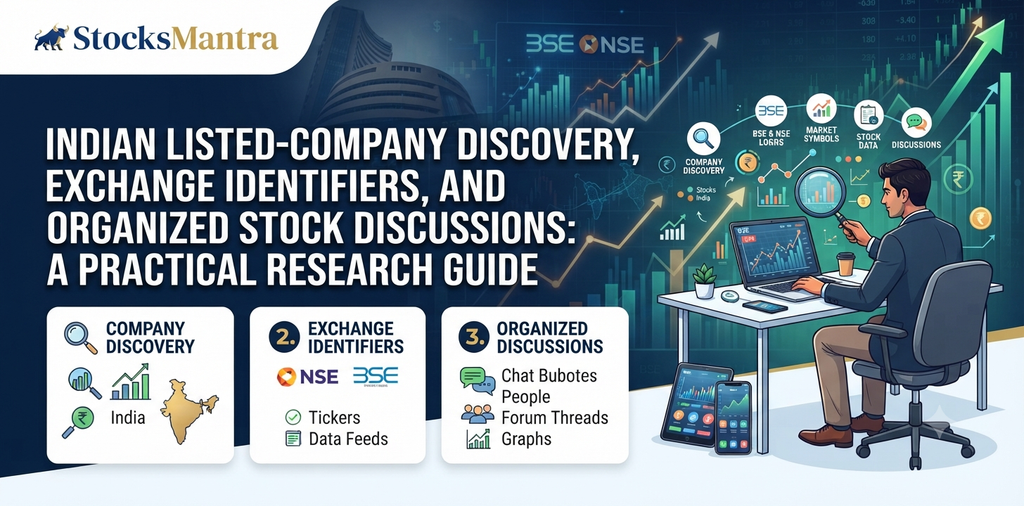
Researching publicly traded companies in India starts with a basic practical step: confirming that you are looking at the right business on the right exchange. Thousands of companies trade across Indian equity markets, and many share similar words in their corporate names, operate multiple subsidiaries, or trade across different market segments. Without reliable company identifiers and structured reference pages, investors can easily confuse two separate entities before they even open an annual report or read a quarterly filing.
Once you confirm the exact listed security, the next challenge is organizing information. Financial disclosures, corporate announcements, and investor viewpoints often scatter across exchange websites, news feeds, and general social channels. Combining a structured company directory with company-centered discussions helps retail investors, traders, and financial researchers connect official exchange records with focused peer conversations.
Why Listed-Company Discovery Matters to Indian Investors
India’s public equity market spans thousands of businesses across banking, manufacturing, information technology, pharmaceuticals, consumer goods, infrastructure, and emerging services. Investors access these companies primarily through two nationwide stock exchanges: the National Stock Exchange of India (NSE) and BSE Limited. Some companies list on both exchanges, while many smaller or regionally established firms trade exclusively on one venue.
Relying solely on a company’s spoken or shortened name creates unnecessary risk during initial research. Two businesses may use nearly identical brand words while operating under completely different legal registrations, management teams, and balance sheets. A business may also change its corporate name after a merger, restructuring, or brand realignment while keeping its underlying security record intact.
New market participants often struggle when they encounter unfamiliar tickers, numeric codes, or unfamiliar market tiers. Checking official exchange details and listing records at the outset prevents basic identification errors. A structured discovery process lets you verify a company’s exact listing venue, segment classification, and external disclosure links before studying its financial performance.
Understanding India’s Listed-Company Information System
Public company records in India follow a standardized regulatory framework overseen by the Securities and Exchange Board of India (SEBI) and administered day to day by the stock exchanges. Understanding how these pieces fit together helps you trace any listed security back to its primary source.
- National Stock Exchange of India (NSE): The NSE maintains official company directories, corporate announcement feeds, shareholding patterns, and financial result filings for securities admitted to trading on its mainboard and SME platform.
- BSE Limited: As Asia’s oldest stock exchange, BSE hosts one of the largest rosters of listed Indian companies, publishing corporate filings, scrip details, corporate action notices, and historical disclosures.
- Company Disclosures: Under SEBI’s Listing Obligations and Disclosure Requirements (LODR) regulations, listed entities must file material events, quarterly financial statements, board meeting outcomes, and annual reports directly with the exchanges where their shares trade.
- Exchange Trading Identifiers: Each exchange assigns its own trading identifier—an alphabetical symbol on the NSE and a six-digit numeric scrip code on the BSE—to route orders and organize market data accurately.
- Official Listing Information: Exchange records indicate whether a security is active, suspended, listed on the mainboard, or admitted to a Small and Medium Enterprises (SME) segment.
Treating exchange records as your primary reference point ensures that secondary research, forum notes, and third-party summaries remain anchored to verified public filings.
Exploring a Structured Directory of Indian Companies
Browsing thousands of individual exchange pages one by one can feel overwhelming when you are scanning sectors or looking up unfamiliar names. A structured NSE BSE listed companies list brings basic security metadata together in one searchable index so you can locate businesses efficiently.
A well-organized company directory supports initial discovery in several practical ways:
- Alphabetical Browsing: Allows researchers to scan company names systematically when they only remember part of a business’s registered title.
- Exchange-Based Filtering: Helps separate companies listed on the NSE, the BSE, or both venues, clarifying where price discovery and corporate filings occur.
- Mainboard and SME Classification: Distinguishes established mainboard listings from smaller enterprises trading on dedicated SME platforms.
- Listing-Status Information: Displays recorded status indicators so users can see whether a security is listed as active or carries a different recorded status.
- Individual Company Pages: Consolidates core identifiers, segment labels, and dedicated discussion threads onto a single reference page for each company.
- External Research References: Connects users directly to primary exchange portals and established financial screening tools for deeper number-crunching.
StocksMantra.in organizes this workflow as an informational directory paired with community discussion threads. Based on a September 23, 2026 platform snapshot, the StocksMantra directory indexed 6,063 NSE and BSE listed companies with individual company pages and associated discussion threads. Because corporate listings, mergers, and exchange statuses change over time, readers should treat that figure as a dated snapshot rather than a live tally and confirm current status directly on NSE or BSE portals.
Understanding the Different Identifiers Used for Listed Companies
Every listed Indian security carries multiple identifiers because different market systems serve different functions. Knowing what each code represents prevents mix-ups when moving between brokerage screens, exchange websites, and research databases.
| Identifier Type | Format & Issuer | Primary Purpose | Key Distinction |
| Company Name | Legal text string registered with the Registrar of Companies | Identifies the corporate legal entity | Can change over time and may resemble names of unrelated businesses |
| NSE Trading Symbol | Alphanumeric ticker assigned by NSE | Identifies the security for trading and filings on NSE | Applies specifically to NSE; not used for order routing on BSE |
| BSE Scrip Code | Six-digit numeric code assigned by BSE | Identifies the security for trading and filings on BSE | Unique to BSE; remains distinct from NSE alphabetical tickers |
| ISIN | 12-character alphanumeric code (starts with INE for Indian corporate equities) | Globally standardizes security identification across depositories (NSDL/CDSL) and exchanges | Identifies the specific security itself, not the company name or exchange venue |
An International Securities Identification Number (ISIN) is strictly a security-level code overseen in India through the depository system. You should never confuse an ISIN with a company’s legal name or its exchange trading symbol. Two companies with similar sounding names will always carry completely separate ISINs, making the ISIN the cleanest cross-check when verifying that an NSE symbol and a BSE scrip code point to the exact same underlying equity share.
Finding Companies Through Exchange Identifiers
In everyday research, investors rarely start with all four identifiers in hand. You might hear a ticker mentioned in a financial broadcast, spot a numeric code on a contract note, or read a legal name in a newspaper notice. Using identifier-specific lookup tools bridges those gaps quickly.
Performing an NSE stock symbol search is especially useful when you know a short trading ticker—such as a concise abbreviation used in market commentary—and need to confirm the full registered corporate name, ISIN, and listing segment behind it. Because NSE symbols are short alphabetical strings, checking the full company profile prevents guessing wrong on abbreviated names.
Similarly, a BSE scrip code search lets you enter a six-digit BSE numeric code to pull up the corresponding company record. Many older regulatory notices, physical share certificates, and BSE corporate announcements reference the scrip code prominently, making numeric lookup essential for tracing historical filings on BSE.
When you want to verify that two records across different websites refer to the exact same security—or confirm whether an equity share has undergone a split or restructuring that issued a new security code—running an ISIN lookup for Indian stocks provides an unambiguous match. While directory search tools make locating these identifiers straightforward, you should always cross-check critical corporate actions or active trading status against official NSE and BSE quote pages.
Understanding Mainboard and SME Listings
Indian stock exchanges operate two primary equity listing tiers: the Mainboard and the SME platforms (NSE Emerge and BSE SME). Both segments operate under SEBI’s regulatory oversight, yet they serve businesses at different stages of scale and maturity.
- Listing Segments and Purpose: Mainboard segments host larger, more established corporations that meet higher paid-up capital, net worth, and track-record thresholds. SME platforms were created to help smaller and growing enterprises raise public equity capital without meeting full mainboard size requirements.
- Company Size and Business Stage: Mainboard companies often operate across multiple regions or product lines with longer operating histories. SME-listed businesses typically have smaller revenue bases, narrower product concentrations, and shorter histories as public entities.
- Liquidity and Trading Considerations: Mainboard shares generally see higher daily trading volumes and narrower bid-ask spreads, though liquidity still varies widely among individual stocks. Many SME listed companies India experience lower trading frequency, wider spreads, and minimum lot-size trading rules that affect how easily investors can enter or exit positions.
- Disclosure and Reporting: Mainboard companies generally report financial results on a quarterly basis, whereas SME-listed companies typically file half-yearly financial results under SEBI LODR norms, alongside material event disclosures.
- Research Availability: Institutional analysts and financial media cover hundreds of mainboard companies regularly. Independent analyst coverage for SME companies is far sparser, placing greater responsibility on individual investors to read primary filings.
An SME listing tag is neither a badge of guaranteed high growth nor an automatic warning sign. Each business must be evaluated on its own financial filings, cash flows, customer concentration, and governance disclosures rather than its listing tier alone.
Why Company-Specific Investor Discussions Can Be Useful
General financial social media often mixes macroeconomic debates, index commentary, memes, and unrelated stock tips into a single fast-moving stream. When you are researching one specific business, digging through thousands of unrelated posts wastes time and buries useful observations.
Organizing conversations around individual listed companies changes how information flows:
- Easier Discovery of Relevant Conversations: Grouping posts under a dedicated company thread lets researchers find past and ongoing discussions about that exact business in seconds.
- Following Company Announcements: When a company files a board outcome, order win, or capacity expansion notice, members can discuss the specific filing in one place.
- Sharing Research Observations: Readers can highlight details buried in footnotes of an annual report, segment revenue breakdowns, or regulatory filings that others might overlook.
- Comparing Different Viewpoints: Constructive threads bring together bull and bear perspectives, helping readers spot operational risks alongside growth drivers.
- Learning from Experienced Participants: Beginners can observe how seasoned researchers read balance sheets, question accounting assumptions, and verify exchange disclosures.
StocksMantra follows this company-centered model by linking dedicated discussion threads directly to individual company pages, functioning as an Indian stock market discussion forum structured around specific listed entities rather than scattered timelines.
Discussing Company Performance and Financial Results
Periodic earnings releases are among the most active moments for company-specific research. When a business publishes its financial statements, investors look beyond headline profit numbers to understand operational health.
Key items investors commonly examine include:
- Revenue and Topline Growth: Whether core operating income grew through higher sales volumes, better pricing, or one-time gains.
- Operating Margins: How much profit the business retains from operations after direct production and employee expenses, showing cost control and pricing power.
- Profit and Loss and Earnings Per Share (EPS): Net profitability after interest, depreciation, and taxes, tracked on a per-share basis to account for equity dilution.
- Debt Levels and Finance Costs: Total borrowings relative to equity and whether interest expenses consume a growing share of operating profit.
- Cash Flow from Operations: Whether accounting profits actually convert into real cash entering the bank account, or remain tied up in unpaid receivables and unsold inventory.
- Year-on-Year (YoY) and Quarter-on-Quarter (QoQ) Comparisons: Comparing results against the same quarter last year adjusts for seasonal business cycles, while sequential comparisons highlight recent momentum.
- Management Commentary and Exchange Disclosures: Notes to accounts, auditor remarks, and earnings call transcripts that explain why margins expanded or contracted.
A single strong or weak quarter rarely tells the full story of a business. Productive quarterly results discussion Indian stocks threads compare multi-year trends, check cash conversion alongside net profit, and refer directly to the PDF financial results uploaded to the NSE or BSE.
Sharing Fundamental Research and Technical Market Observations
Investors study listed businesses through two distinct analytical lenses: fundamental research and technical analysis. Both approaches appear frequently in stock discussions, and keeping them clearly separated prevents confusion.
Fundamental Research focuses on the underlying business and its financial durability:
- Business Model and Industry Position: How the company makes money, who its customers are, and whether it holds competitive advantages within its sector.
- Revenue, Profit, and Cash Flow Trends: Multi-year consistency in sales growth, return ratios, and free cash flow generation.
- Balance Sheet and Debt Profile: Asset quality, working capital discipline, and leverage levels during different economic cycles.
- Corporate Governance: Promoter shareholding trends, related-party transactions, pledging of shares, and transparency in shareholder communication.
- Valuation Considerations: Comparing current market price against earnings, cash flows, book value, and historical sector multiples.
Technical Analysis examines market price action and trading behavior:
- Price Trends and Moving Averages: Identifying whether a stock is trading in an uptrend, downtrend, or sideways consolidation range.
- Trading Volume: Checking whether price movements are supported by strong participation or thin liquidity.
- Support and Resistance Levels: Historical price zones where buying or selling interest has repeatedly emerged.
- Chart Patterns and Momentum Indicators: Visual price structures and oscillators used by traders to manage entry, exit, and risk levels.
In any fundamental analysis discussion Indian stocks or technical thread, clear contributors state whether an observation reflects audited financial statements, a chart setup, or a personal hypothesis. Mixing short-term price charts with long-term business valuation arguments without labeling them leads to muddled conclusions.
Understanding Small-Cap and Less-Discussed Companies
Large-cap companies attract constant coverage from brokerage desks, institutional funds, and business television. By contrast, small-cap businesses and niche listed firms often receive far less mainstream attention, which leads independent researchers to explore them through directories and peer forums.
Researching smaller companies involves distinct practical considerations:
- Availability of Reliable Information: Fewer third-party research reports mean investors must rely directly on annual reports, credit rating rationales, and exchange filings.
- Trading Liquidity and Price Volatility: Lower free-float shares and smaller daily volumes can cause sharper percentage price swings on relatively modest buy or sell orders.
- Business Concentration: Smaller firms may depend heavily on a single manufacturing plant, a handful of major clients, or one regional market.
- Corporate Governance and Reporting Quality: Scrutinizing auditor notes, contingent liabilities, and related-party dealings becomes especially important when institutional oversight is lower.
- Risks of Rumors and Unsupported Claims: Thinly traded stocks are more vulnerable to unverified social media chatter, exaggerated order-book rumors, and coordinated hype.
Participating in a small cap stocks discussion India works best when contributors share verifiable data points from public filings rather than treating heavy forum chatter as proof of business quality. High discussion volume around a small stock reflects community interest, not guaranteed future returns.
How a Company-Centered Forum Organizes Market Conversations
Even when a platform centers on individual stocks, investors still need space for broader market context, analytical frameworks, and beginner questions. Separating macro and educational conversations from company-specific threads keeps individual stock pages clean and focused.
In a structured community layout like StocksMantra’s, conversations typically divide across dedicated company threads alongside broader forum areas:
- Company-Specific Threads: Tied directly to an individual NSE or BSE listed company page, keeping discussions about earnings, corporate actions, and business updates anchored to that single entity.
- Market Discussions: Covers broader market developments, sector trends, regulatory updates, and macro news that affect multiple companies rather than one isolated business.
- Investing & Analysis: Focuses on research methodologies, valuation frameworks, fundamental and technical concepts, and portfolio risk management principles.
- Community: Provides space for stock market beginners to ask foundational questions, share platform feedback, and learn how to navigate exchange disclosures without cluttering company-specific research threads.
Keeping these layers distinct helps a researcher check a company’s dedicated thread for business-specific updates while browsing broader categories to sharpen general analytical skills.
Using Public Information to Support Better Stock Discussions
Thoughtful market communities treat online conversations as a starting point for inquiry rather than a substitute for primary documents. Every factual claim about revenue, debt, promoter holding, or corporate actions can be checked against authoritative public records.
Reliable primary and secondary sources for Indian equity research include:
- NSE and BSE Corporate Announcements: Real-time filings for board meetings, financial results, dividend declarations, bonus issues, stock splits, rights issues, and material contracts.
- Company Annual Reports: Comprehensive yearly documents containing the management discussion and analysis (MD&A), corporate governance report, auditor’s report, and audited standalone and consolidated financial statements.
- Quarterly Financial Statements and Investor Presentations: Detailed quarterly numbers paired with management slides explaining operational drivers, capacity utilization, and industry outlook.
- Regulatory Filings: Shareholding pattern disclosures, insider trading (PIT) disclosures, and substantial acquisition (SAST) filings hosted on exchange portals.
- External Screening and Research Tools: Platforms such as Screener.in and Trendlyne—linked as external research references on StocksMantra company pages—help organize multi-year financial ratios, peer comparisons, and shareholding summaries for quicker review.
External screening platforms save significant time during initial number-crunching, yet primary exchange filings remain the final authority whenever numbers need verification.
Responsible Participation in Online Stock Market Communities
Online financial forums carry inherent risks when contributors blur the line between objective analysis and speculative promotion. Common pitfalls across unmoderated stock boards include unverified tips, fabricated order-book rumors, selective screenshot cherry-picking, pump-and-dump coordination, spam, undisclosed conflicts of interest, and unauthorized personalized investment advice.
Responsible community participation relies on clear standards from both platform guidelines and individual members:
- Prohibited Conduct: StocksMantra’s stated community rules prohibit market manipulation, misleading claims, spam, and unauthorized personalized investment advice, supported by moderation workflows for new contributors and flagged posts.
- Cite Verifiable Sources: Reference specific exchange filings, annual report pages, or official announcements when stating financial figures or corporate events.
- Separate Facts from Opinions: Clearly distinguish audited historical data from personal forecasts, valuation assumptions, or technical interpretations.
- Avoid Guaranteed Predictions: No contributor can know future share prices with certainty; avoid target-price hype or language implying guaranteed returns.
- Disclose Uncertainty: Acknowledge gaps in public data, unanswered questions in financial footnotes, or risks that could invalidate an investment thesis.
- Treat Forum Posts as Peer Perspectives: Never treat community comments as personalized buy, sell, or hold instructions.
Remember that under SEBI regulations in India, personalized investment advice may only be provided by SEBI-registered investment advisers (RIAs) or appropriately licensed entities—not by anonymous or peer forum participants.
How StocksMantra Supports Company Discovery and Discussion
StocksMantra.in brings listed-company reference data and structured investor conversations together in one informational workspace. Rather than operating as a stockbroker, trading terminal, exchange, or regulated investment advisory service, the platform focuses on helping users locate listed companies and follow organized discussions around them.
Its core workflow combines several practical elements:
- Searchable NSE and BSE Company Directory: Indexes Indian listed companies with alphabetical browsing and exchange-level visibility.
- Exchange Identifier Lookups: Supports searching by company name, NSE trading symbol, BSE scrip code, or ISIN so users can pinpoint exact securities.
- Mainboard and SME Filtering: Helps readers identify whether a listed company trades on a mainboard segment or an SME platform.
- Individual Company Information Pages: Displays core security identifiers, segment classification, recorded listing status, and external research links to NSE, BSE, Screener.in, and Trendlyne.
- Company-Specific Discussion Threads and Categories: Connects each listed company to its own discussion thread while organizing broader conversations across Market Discussions, Investing & Analysis, and Community sections.
Used alongside official exchange portals and primary company filings, these features help retail investors and researchers keep their discovery notes and peer discussions organized in one place.
Frequently Asked Questions
What is the difference between an NSE symbol and a BSE scrip code? An NSE symbol is an alphabetical or alphanumeric trading ticker assigned by the National Stock Exchange, while a BSE scrip code is a six-digit numeric identifier assigned by BSE Limited. Both identify the company on their respective exchanges for trading and corporate filings, and dual-listed companies carry both identifiers simultaneously.
What is an ISIN and why is it used? An ISIN (International Securities Identification Number) is a unique 12-character alphanumeric code assigned to a specific security rather than a trading venue. For Indian corporate equities, it typically starts with “INE” and is administered through NSDL and CDSL. Investors use it to confirm that records across different exchanges or platforms refer to the exact same share class.
How can investors verify whether a company is listed on the NSE or BSE? Investors can check the official corporate directories and quote search bars directly on the NSE India and BSE India websites using the company’s legal name, trading ticker, numeric scrip code, or ISIN. Official exchange quote pages display active trading status, market segment, and recent regulatory filings.
What is the difference between mainboard and SME-listed companies? Mainboard companies are generally larger, more established businesses that meet higher capital and track-record requirements and typically file quarterly financial results. SME-listed companies trade on NSE Emerge or BSE SME, which help smaller growing enterprises raise equity capital; they usually file half-yearly financial results and often experience lower trading liquidity.
Why are company-specific stock discussions useful? Company-specific discussion threads keep all commentary, earnings observations, and filing breakdowns about one business in a single place. Instead of scrolling through unrelated market chatter, researchers can quickly review past discussions, compare differing viewpoints on business risks, and follow ongoing developments for that exact company.
What information should investors review in quarterly results? Beyond headline net profit, investors typically review core revenue growth, operating profit margins, earnings per share, interest costs, and year-on-year as well as quarter-on-quarter comparisons. Reading the management commentary, notes to accounts, and cash flow disclosures in the official exchange filing provides essential context behind the numbers.
How can investors verify information shared in stock market forums? Any financial figure, order announcement, shareholding change, or corporate action mentioned in a forum post should be cross-checked against official corporate announcements, annual reports, and financial statements published on the NSE or BSE websites. Primary exchange filings always take precedence over user summaries or screenshots.
What is the difference between fundamental and technical analysis? Fundamental analysis evaluates a company’s underlying financial health, business model, balance sheet, cash flows, governance, and intrinsic valuation. Technical analysis studies historical share price movements, trading volumes, chart patterns, and support or resistance levels to understand market sentiment and timing.
Final Thoughts on Better Company Research and Investor Conversations
Sound equity research begins with getting the basics right: confirming the exact company through its NSE symbol, BSE scrip code, and ISIN, understanding whether it trades on the mainboard or an SME platform, and reading primary disclosures filed with the exchanges. Skipping those foundational steps makes it far too easy to misread financial data or confuse similarly named businesses.
Organizing discussions around individual listed companies adds structure to how retail investors share observations, question quarterly numbers, and compare fundamental or technical viewpoints. By using informational platforms like StocksMantra.in as a discovery and discussion companion—while verifying every material fact against official NSE, BSE, and company filings—Indian investors can build more disciplined, transparent, and independent research habits.

