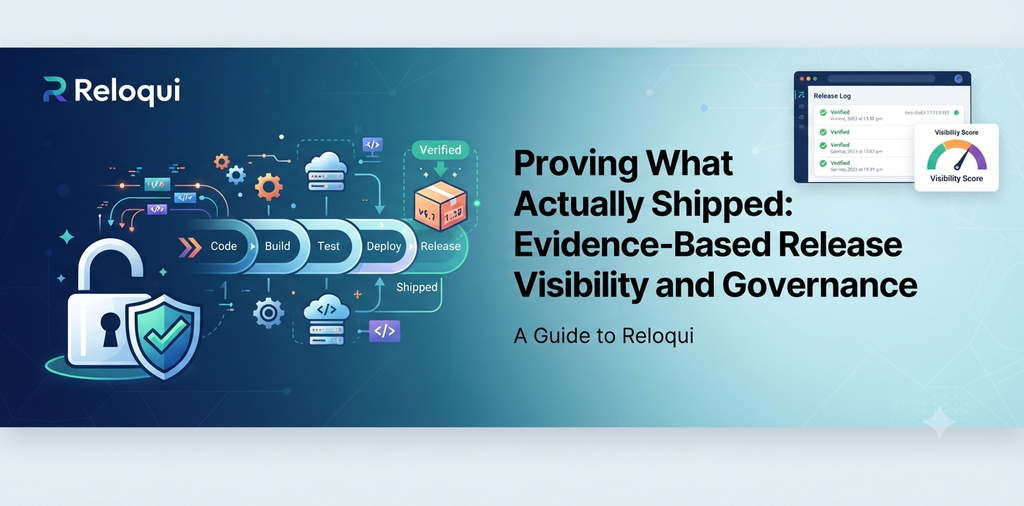
Introduction
A green pipeline or a successful deployment notification does not always tell you what actually reached production. A build can pass while an expected container image never lands in the registry, a hotfix can merge without a linked issue key, or a deployment can run against a different revision than the tag named in a release note.
When engineering teams ship dozens or hundreds of changes a week across microservices, pipelines, and cloud infrastructure, knowing the exact contents and deployment state of a version becomes hard. That gap matters even more when an incident occurs, when a release stalls before rollout, or when an auditor asks who approved a production change.
A dependable release record needs more than a status label. It requires connected engineering evidence from source control, issue trackers, continuous integration and continuous delivery (CI/CD, automating build, test, and deployment workflows) pipelines, artifact registries, deployment targets, and infrastructure tools. Platforms like Reloqui approach this challenge as a release intelligence platform that reconciles raw signals from existing engineering systems into a unified, explainable release record rather than replacing the tools teams already use.
Why Traditional Software Release Tracking Becomes Difficult
Most software organizations already collect plenty of data about their work, yet that data rarely lines up cleanly around a single version. Information sits in separate tools built for different stages of delivery, each with its own identifiers, timestamps, and workflows.
- Fragmented engineering tools: Code reviews live in GitHub, GitLab, or Bitbucket, work items sit in Jira or Linear, builds run in CI/CD systems, images land in container registries, and infrastructure shifts in Terraform. Stitching those pieces together by hand takes time and invites mistakes.
- Manual spreadsheets and status updates: Release managers often chase engineers in chat threads or update shared spreadsheets before a launch window. By the time a status table is compiled, new commits or hotfixes may have already changed what is slated to ship.
- Unlinked commits and issues: Developers sometimes open a pull request or merge a quick fix without referencing a ticket key. Without explicit linkage, teams struggle to answer why a change went into production or which customer request or bug report it addressed.
- Build success versus deployment reality: A pipeline job can finish green while a downstream deployment step fails, targets a staging cluster instead of production, or deploys an older artifact digest. Treating a green build as proof of production delivery blurs what is built with what is running.
- Missing artifact or environment records: If an artifact is pruned, overwritten, or published outside the expected pipeline, or if a deployment log lacks environment metadata, teams lose visibility into what binary or image corresponds to a release version.
- Inconsistent release documentation: Release notes written from memory or partial commit logs often omit important changes, misstate scope, or mix technical implementation details with product impact.
- Limited cross-team visibility: Product managers want to know what features shipped, site reliability engineers (SREs, engineers applying software engineering practices to reliability and operations) need to know what changed before an incident, and compliance teams need verifiable records. A single flat changelog rarely serves every audience well.
Consider a common scenario: a team prepares a version v2.4.0 of a billing service. During the release window, an engineer merges an urgent patch directly to the release branch without a Jira issue key, and a force-push rewrites commit history on a working branch. Even if the deployment job reports success, relying on a manual checklist makes it easy to miss the unlinked patch or misread which commit actually went live.
Understanding Evidence-Based Release Intelligence
Release intelligence focuses on gathering, connecting, and evaluating technical evidence from across the software delivery lifecycle so teams can see what changed, where it went, and how much trust to place in the record. Instead of relying on self-reported status updates, it treats events from source control, trackers, builds, registries, deployments, and infrastructure as structured evidence.
Basic version tracking tells you a tag or release number exists. Deployment monitoring tells you whether a rollout job ran or whether a service instance is healthy after a change. Release intelligence sits between and above those views by reconciling the chain of evidence that ties planned work, code changes, built artifacts, infrastructure updates, and deployments to a specific release version.
In that category, Reloqui is designed to work alongside existing engineering tools rather than replace them. It ingests events from connected systems, models services and environments, reconciles release evidence, calculates transparent confidence scores, and supports governance workflows while keeping every claim tied back to underlying records.
How Release Evidence Is Connected Across Engineering Systems
Reliable traceability depends on linking distinct records across the tools engineers use every day. Each system captures a different part of the delivery story:
- Source-control repositories: Provide commits, branches, tags, pull or merge requests, review approvals, and history events such as force pushes.
- Issue-tracking systems: Capture feature requests, bugs, tasks, and status transitions that explain the intent behind a change.
- CI/CD pipelines and build records: Show when builds ran, whether tests and build steps passed or failed, and which commit produced a build.
- Artifact registries: Record published packages, container images, or binaries—and help verify whether an expected artifact actually exists.
- Deployment environments and infrastructure changes: Capture where a release was deployed (such as staging or production), when it happened, and whether infrastructure definitions changed via tools like Terraform.
- Incident information: Connects post-release rollbacks, alerts, or incident records back to the release window so teams can investigate what changed.
Traceability works best when a single change can be followed from start to finish. Suppose a support ticket PAY-418 is created for a payment timeout. A developer opens a pull request referencing PAY-418, gets peer review approval, and merges it into the main branch. A CI pipeline builds the service and publishes a versioned artifact to the registry, and a deployment workflow rolls that artifact out to production.
In practice, teams frequently use GitHub Jira release tracking workflows to connect pull requests and commits with Jira issue keys so work items and code changes stay aligned. Connecting those signals with build logs, artifact records, and deployment events closes the loop between what was requested, what was coded, what was built, and what reached a live environment.
Understanding Release Reconciliation and Confidence Scoring
Collecting raw events is only the first step. Events arrive asynchronously, sometimes out of order, with clock drift across systems or incomplete metadata. Reconciliation is the process of bounding a release window, gathering relevant events, normalizing timestamps, attributing changes to a service and version, and classifying each item so teams get a coherent picture.
According to Reloqui’s technical documentation, its 11-stage reconciliation engine processes release evidence through structured stages: scope resolution, evidence collection, clock-skew normalization, deterministic attribution, heuristic attribution, item classification, backport detection, force-push handling, confidence scoring, policy evaluation, and snapshot persistence. Rather than guessing silently when signals are ambiguous, the engine separates deterministic links (such as explicit repository or issue-key matches) from heuristic rules (such as branch or commit-text patterns) and flags items that are uncertain or orphaned.
Why Confidence Scores Must Be Explainable
A single numeric score or color badge is useful only if engineers can see why it moved up or down. In Reloqui’s scoring model, a release confidence score between 0 and 1 (grouped into high, medium, and low tiers) combines positive evidence signals—such as a tag anchor, linked issues, published artifacts, deployments, clean history, and passing builds—with deductions when evidence is missing or contested, such as missing artifacts or deployments, orphaned changes, force-pushes, high reliance on heuristic matching, or rollbacks. When a team has not connected a delivery source, the model marks a coverage gap rather than penalizing the release for missing deployment data it had no way to collect.
Equally important, a confidence score is an assessment of evidence completeness and consistency, not a guarantee that code is bug-free, performant, or secure. A release can have high evidence confidence because every PR, build, artifact, and deployment is cleanly linked, yet still contain a logic defect. Conversely, a release can have a lower score because a hotfix bypassed normal ticket conventions, even if the code itself works.
Keeping Uncertainty Visible
Hiding missing links or conflicts behind a single “ready” or “complete” label creates false certainty. When an orphaned change appears, a force-push rewrites history, or a deployment record is missing, surfacing those items as exceptions lets engineers inspect the exact gap before shipping. Visible uncertainty prompts targeted verification instead of blind trust.
Improving Release Readiness Before Production Deployment
Deciding whether a release is ready for production involves checking several practical questions at once:
- Evidence completeness: Are the expected pull requests, issues, builds, artifacts, and deployment records present for the release window?
- Build and artifact status: Did required builds pass, and is the target artifact available where deployments expect it?
- Environment and deployment context: Which target environment is next, and what baseline version is being compared?
- Unresolved changes and exceptions: Are there orphaned changes, uncertain attributions, force-pushes, or recent rollbacks that need a second look?
- Policy and exception alignment: Does the release meet team standards, or has an explicit exception been documented for a known gap?
Using release readiness assessment software helps teams organize these checks consistently before a rollout instead of relying on memory or ad-hoc chat messages. Policy thresholds and exception lists can highlight when a release has gaps that require attention.
Even so, software cannot replace human engineering judgment. An SRE or release lead still needs to weigh operational context—such as traffic patterns, database migrations, dependency health, or upcoming maintenance windows—before deciding whether to proceed or hold.
Building Consistent Release Approval and Governance Practices
As delivery frequency increases, informal approvals—such as a quick nod in a team channel—become hard to track and defend later. Structured governance gives teams clear rules for how releases move forward and how exceptions are handled.
Key governance practices include:
- Clear approval responsibilities: Defining who can approve a release, preventing self-approval where appropriate, and recording decision history.
- Confidence thresholds and policy gates: Requiring minimum evidence standards or blocking progression when exceptions exceed agreed limits.
- Release freeze windows: Establishing periods—such as peak retail events or major migrations—when routine releases are paused unless an explicit waiver or approval is granted.
- Exception handling: Documenting why a release proceeded despite missing evidence or a policy warning, rather than silently ignoring the rule.
- Immutable release snapshots: Freezing the release state, evidence list, policy evaluation, and approval record at publish time so the record cannot be altered retroactively.
Release approval workflow software makes these steps repeatable and visible across teams. If late evidence changes a release—for example, a force-push invalidates earlier commits after an approval was requested—automatic status updates or approval suspension can alert reviewers so stale sign-offs do not slip through.
Audit Records vs. Formal Compliance Certifications
A well-structured software release audit trail helps teams answer operational and audit questions quickly: what changed, when was it built or deployed, what evidence supported it, and who approved it. Immutable snapshots and clear approval logs make internal reviews and external audits far smoother.
However, a release audit trail is not the same thing as a formal compliance certification (such as SOC 2 or ISO 27001), a security audit, or a regulatory sign-off. Those certifications evaluate broader organizational controls, policies, infrastructure security, and independent auditor testing across an entire scope. Release evidence supports compliance readiness by providing reliable change records, but it does not replace a formal audit or certification program.
Creating Better Release Notes and Documentation
Manually assembling release notes at the end of a sprint or release cycle is tedious and error-prone. Teams often pull titles from merged pull requests, skim Jira tickets, and guess at what actually made it into the build—only to find out later that a ticket was moved out of scope or a hotfix went in at the last minute.
An automated release notes generator can draft summaries directly from reconciled release evidence, grounding each entry in verified pull requests, issues, artifacts, and deployments rather than memory. Because the underlying evidence is structured, teams can tailor summaries to different readers without maintaining separate manual trackers from scratch:
- Engineering teams: Need technical details, pull request references, build or artifact context, backports, and noted exceptions.
- Operations and SRE teams: Care about affected services, deployment targets, configuration or infrastructure changes, rollbacks, and potential impact.
- Product managers: Look for user-facing features, bug fixes, and scope changes tied to product goals.
- Executives: Benefit from concise rollups showing delivery flow, release readiness, and high-level risks across services.
- Compliance and governance reviewers: Need clear links between changes, approvals, exceptions, and immutable release records.
Automated generation speeds up drafting, but human review still matters. Automated notes may lack product context, use terse commit wording, or reflect incomplete metadata when upstream systems are poorly tagged. Having an engineer or product owner review generated notes before external sharing keeps communication accurate and clear.
Understanding Deployment Activity Across Environments
Tracking a release is not just about knowing code was merged; it is about following that change from build to artifact to target environment. A service might be built once, promoted through testing or staging, and deployed to production—or it might be rolled back after an issue surfaces.
A CI/CD deployment tracking dashboard helps teams see deployment activity across environments, spot stalled or failed rollouts, and check which version is running where. Visibility across environments is especially helpful when multiple teams deploy independently or when hotfixes run alongside scheduled releases.
It helps to keep three concepts distinct:
- Pipeline monitoring: Tracks whether CI/CD jobs and workflows run, succeed, fail, or time out.
- Deployment tracking: Records deployment events and target environments so teams can see what was rolled out where.
- Release-level evidence reconciliation: Connects source changes, issues, builds, artifacts, deployments, and exceptions into a cohesive view of a specific release version.
Together, these layers give engineers both real-time operational awareness of pipelines and deployments and a structured historical record of what each release contains.
Improving Change Traceability and Service Impact Analysis
In distributed systems, a change to one service rarely affects only that service in isolation. An API update, shared library change, queue consumer adjustment, or Terraform infrastructure modification can ripple across upstream and downstream components.
Strong software release change traceability connects a release back to the code changes, issues, and infrastructure updates behind it, while linking that release to the services and environments involved. When paired with a service catalog and dependency graph—mapping relationships such as service calls, dependencies, or event publishers—teams can see which components sit nearby and inspect how one release compares with a baseline version.
Impact analysis helps engineers ask better questions before and after a release: which services depend on this component, what changed since the last known good version, and where should we look first if latency spikes? Still, no dependency graph can map every hidden runtime dependency or predict every production failure. Dynamic traffic patterns, third-party outages, and subtle configuration interactions mean dependency visibility is a strong investigative aid, not a crystal ball.
Choosing Between Self-Hosted and Managed Deployment
Organizations adopting release tooling generally choose between running the software on their own infrastructure or using a vendor-managed service. Each model shifts operational responsibility in distinct ways:
| Dimension | Self-Hosted Deployment | Managed Deployment |
| Infrastructure ownership | Run and maintain servers, storage, and networking within your own environment. | Vendor provisions and manages underlying hosting infrastructure. |
| Data control | Release records and operational data stay inside your own infrastructure boundary. | Data resides in vendor-managed environments subject to agreed isolation and security terms. |
| Upgrades and maintenance | Your team schedules and applies application updates, patches, and configuration changes. | Vendor handles routine platform maintenance and upgrades. |
| Backups and disaster recovery | Your team designs, tests, and runs backup and recovery procedures. | Typically managed as part of the hosted service offering. |
| Support and SLAs | Relies on internal operations teams, documentation, and community or support tiers. | Usually includes defined support channels and service-level commitments. |
| Internal effort and cost | Lower licensing cost can trade off against engineering time spent operating the service. | Higher subscription or hosting cost can reduce internal operational overhead. |
Teams evaluating self-hosted release management software often favor self-hosting when they want direct control over hosting environments and data locality, or when their internal platform team is comfortable operating web applications and databases. Reloqui offers a free self-hosted option with the full feature set alongside a managed enterprise option with dedicated infrastructure, service-level commitments, backups, disaster recovery, and operational support; organizations should verify current plan details, single-server deployment scope, and support terms directly in Reloqui’s documentation and pricing pages when planning a rollout.
Where Reloqui Fits Into an Existing Engineering Toolchain
A dedicated release intelligence platform is most useful when it acts as a reconciliation and visibility layer across your existing tools rather than forcing teams to abandon established workflows. Developers can keep writing code in GitHub, GitLab, or Bitbucket, tracking work in Jira or Linear, building and deploying through their existing CI/CD pipelines, storing artifacts in their registries, and managing infrastructure with Terraform.
In that setup, Reloqui connects to supported sources—advertising twelve connector types across code, issue tracking, CI/CD, registries, infrastructure, and incident workflows—to ingest events, reconcile release windows, compute explainable confidence scores, enforce approval policies and freeze windows, generate audience-specific release notes, and map service relationships. Because it reconciles evidence from existing systems, it complements your toolchain rather than replacing source control, issue trackers, CI/CD runners, or cloud infrastructure.
Practical Considerations Before Adopting a Release Intelligence Solution
Before adopting any release intelligence tool, engineering, platform, and security stakeholders should run a practical evaluation against their actual delivery workflows:
- Connector compatibility: Does the platform support your source-control, issue-tracking, CI/CD, artifact registry, infrastructure, and incident tools, including webhook or polling mechanisms?
- Evidence completeness: How well does it handle missing fields, unlinked pull requests, force-pushes, or environments where certain telemetry is not yet wired up?
- Accuracy and explainability: Can engineers see why a change was included, excluded, marked heuristic, or flagged as an exception, and can they inspect the underlying evidence?
- Deployment coverage: Does it track releases across the services, environments, and release trains your teams actually ship?
- Release approval requirements: Do approval workflows, confidence gates, freeze windows, and exception rules match how your teams review and ship changes?
- Audit record retention: Are release snapshots, approval histories, and evidence links preserved in a way that supports internal reviews and retention needs?
- API and automation needs: Does it offer REST API access, webhooks, or notifications to fit into existing scripts, chat channels, and internal portals?
- Hosting preferences: Do you prefer self-hosting on your own infrastructure or a managed deployment model, and do deployment requirements match your current scale?
- Security and access controls: How does it handle authentication, role-based access control, tenant isolation, and service tokens?
- Operational support: What documentation, community resources, or support options are available when connectors or workflows need troubleshooting?
- Ease of adoption: Can teams start small—perhaps with a read-only demo or a single service—before rolling policies out broadly?
Frequently Asked Questions
What information should a reliable software release record contain?
A reliable release record should identify the version and target service, the commits and pull requests included, linked issues, build outcomes, published artifacts, and deployment history across environments. It should also capture approvals, exceptions such as unlinked changes or force-pushes, and a frozen snapshot of the release state at publish time so teams can verify what shipped later.
How is release tracking different from deployment monitoring?
Deployment monitoring focuses on whether a deployment job ran, succeeded, or caused runtime errors and latency shifts in an environment. Release tracking focuses on the full set of changes, work items, builds, artifacts, approvals, and exceptions associated with a version, helping teams answer what is inside a release and how well-supported that record is.
Why should engineering teams connect source control and issue tracking?
Connecting source control with issue tracking links code changes and pull requests to the feature requests, bug reports, or tasks that motivated them. That connection helps engineers understand why a change exists, helps reviewers check scope, and gives product and audit teams a clear trail from planned work to merged code and deployed versions.
How can teams identify missing release evidence?
Teams can spot missing evidence by checking whether pull requests reference tracked issues, whether builds produced expected artifacts, and whether deployments recorded target environments and versions. Reconciliation tools also flag gaps such as orphaned changes without clear attribution, force-pushes that rewrite history, or missing deployment records when delivery integrations are configured.
What is the purpose of release confidence scoring?
Release confidence scoring summarizes how complete, consistent, and deterministic the supporting evidence for a release is. It helps teams quickly spot thin evidence, unlinked changes, or conflicts that warrant closer review before shipping. It is a guide to evidence quality, not a guarantee that code is free of bugs or security flaws.
How can release approvals be documented?
Release approvals are best documented inside a system that records who approved a release, when the decision happened, what policy checks or freeze windows applied, and whether exceptions were granted. Freezing a release snapshot at publish time and preventing self-approval or unreviewed changes after late edits helps keep approval records dependable.
What should organizations consider when choosing a self-hosted deployment?
Organizations considering self-hosting should weigh data locality and infrastructure control against ongoing operational responsibility. You will need internal capacity to run the application, manage storage, perform backups and disaster recovery, apply upgrades, and monitor health. Teams that prefer vendor-managed operations and formal service-level commitments often compare self-hosting against a hosted option.
How can automated release documentation be reviewed?
Teams can review automatically generated release notes by checking them against the underlying pull requests, issues, and deployment records for that version. Reviewers should verify that technical summaries are accurate, remove or clarify ambiguous wording, add product context where needed, and confirm whether any flagged exceptions or late changes affect the summary.
How do dependency relationships help with release impact analysis?
Mapping relationships between services, components, infrastructure resources, and environments helps engineers see which neighboring systems may be affected by a change. When investigating a risky rollout or a production incident, a dependency graph narrows where to look first, though engineers still need runtime telemetry and judgment because not every dependency is static.
Can a release intelligence platform work with an existing DevOps toolchain?
Yes. Release intelligence tools are designed to ingest signals from existing source-control repositories, issue trackers, CI/CD pipelines, artifact registries, infrastructure tools, and incident systems rather than replace them. Teams can keep their current development and deployment workflows while gaining a centralized place to reconcile evidence, check readiness, and review release history.
Final Thoughts on More Reliable Software Releases
A successful deployment message tells you a job finished, not that you have a complete, trustworthy picture of what changed and why. Reliable release tracking comes from connecting evidence across repositories, issue trackers, builds, artifacts, deployments, and infrastructure—and keeping gaps and uncertainties visible rather than sweeping them under a single status badge.
When teams combine reconciled evidence, transparent confidence assessments, clear approval workflows, dependency context, and tailored release notes, they spend less time reconstructing release history by hand and more time making informed decisions. For organizations looking to bring evidence-backed release visibility to their existing DevOps toolchain, Reloqui provides a practical starting point to evaluate—whether explored through its guided demo, self-hosted option, or managed offering.

